
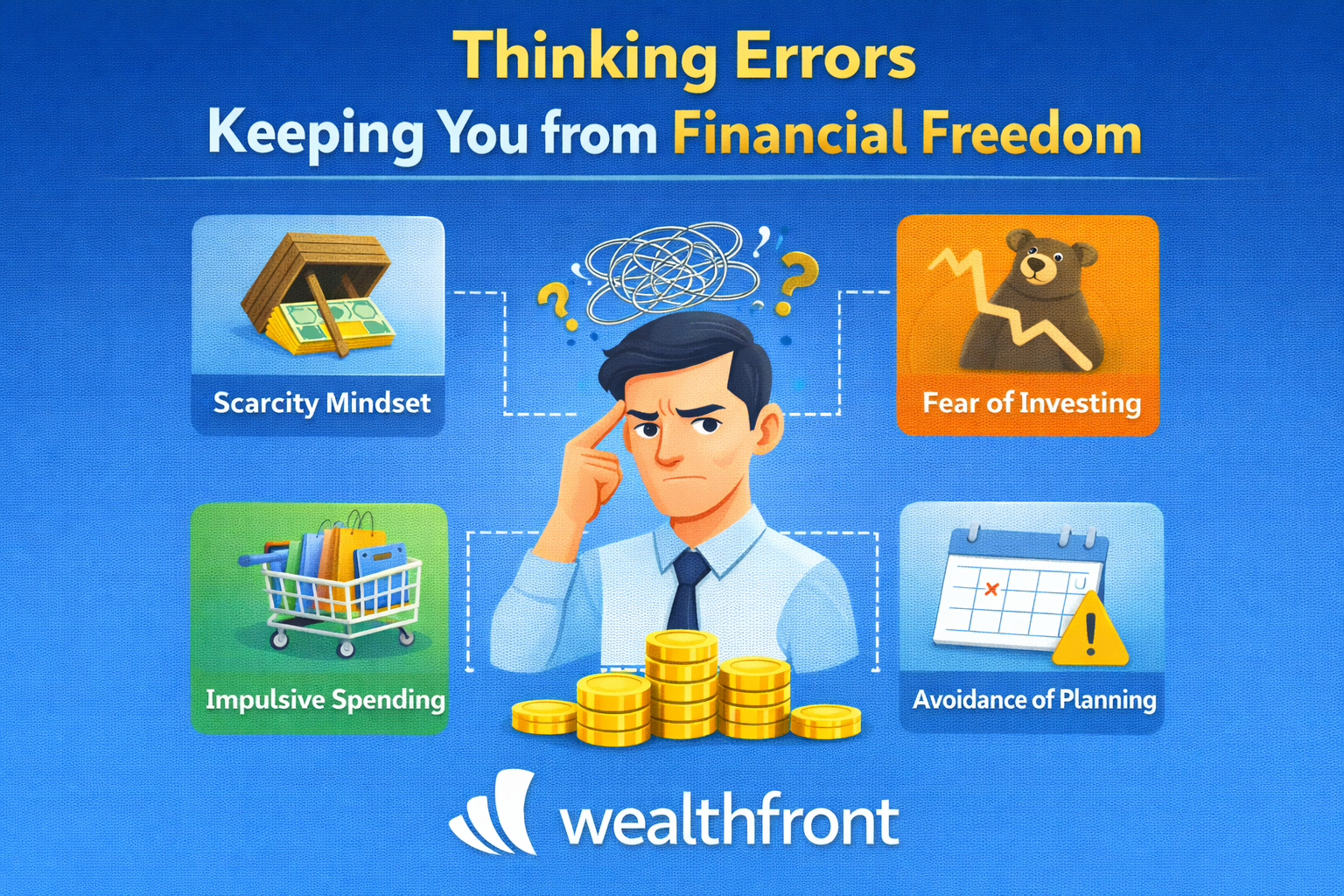
Achieving financial freedom is rarely just about income. Many people with high salaries still struggle financially, while others with modest incomes steadily build wealth.
Why?
The answer often lies in how we think about money.
Research in behavioral finance shows that psychological biases and emotional reactions frequently influence how people save, spend, and invest. These biases can cause individuals to make decisions that work against their own long-term financial interests.
In this guide, we’ll explore the most common thinking errors that prevent people from reaching financial freedom—and how to overcome them.
What Is Financial Psychology?
Financial psychology studies how thoughts, emotions, and personal beliefs influence money decisions.
Many financial choices are not purely logical. Instead, they are shaped by:
-
fear
-
optimism
-
social influence
-
past experiences
Behavioral finance research demonstrates that investors and savers frequently make decisions based on cognitive biases rather than objective analysis.
Understanding these biases is the first step toward building a healthier financial strategy.
Thinking Error #1: The “I’ll Start Later” Trap
One of the biggest obstacles to financial freedom is procrastination.
Many people delay saving or investing because they believe they have plenty of time.
Common thoughts include:
-
“I’ll invest when I make more money.”
-
“I’ll start saving next year.”
-
“I’ll figure it out later.”
The problem with this mindset is lost compounding.
Time is the most powerful force in investing. The earlier you start, the more your money can grow.
Example:
Investing $500 per month starting at age 25 could grow to significantly more than starting at age 35—even if the monthly contribution stays the same.
Waiting costs more than most people realize.
Thinking Error #2: Loss Aversion
Humans naturally fear losses more than they value gains.
This bias is known as loss aversion.
Research shows that people feel the pain of losing money more strongly than the pleasure of gaining it.
This can cause investors to:
-
avoid investing altogether
-
sell investments too early
-
hold losing investments, hoping they recover
Ironically, avoiding risk entirely can also prevent wealth growth.
The key is learning to manage risk rather than avoid it completely.
Thinking Error #3: Overconfidence
Overconfidence bias occurs when individuals believe they understand markets or investments better than they actually do.
This often leads to:
-
excessive trading
-
risky bets
-
chasing speculative investments
Overconfidence is one of the most common biases in behavioral finance and can significantly distort financial decisions.
Successful investors often follow simple rules instead:
-
diversify investments
-
invest consistently
-
minimize fees
-
avoid emotional decisions
Thinking Error #4: Following the Crowd
Humans are naturally social creatures.
When everyone appears to be investing in something—whether it’s a trending stock or cryptocurrency—people feel pressure to join in.
This is called herd mentality.
Unfortunately, herd behavior often leads investors to buy at market peaks and sell during downturns.
Financial history repeatedly shows that the most popular investments at a given moment are not always the best long-term choices.
Disciplined investors focus on strategy, not popularity.
Thinking Error #5: Mental Accounting
Mental accounting occurs when people treat money differently depending on where it came from.
For example:
-
spending tax refunds more freely
-
treating bonuses as “extra money”
-
separating money into rigid categories
While budgeting can be helpful, excessive mental accounting can lead to irrational financial decisions.
Money should always be evaluated based on its opportunity cost—what it could earn if invested wisely.
Thinking Error #6: Short-Term Thinking
Modern culture encourages instant gratification.
Many people focus on:
-
short-term spending
-
quick investment gains
-
immediate rewards
But wealth typically grows through long-term consistency.
Investors who think in decades instead of weeks often achieve better outcomes.
Financial freedom usually results from:
-
disciplined saving
-
long-term investing
-
patience
Thinking Error #7: The Illusion of Control
Some people believe they can predict market movements or control investment outcomes.
This is known as the illusion of control bias.
Markets are influenced by countless variables, including:
-
economic data
-
geopolitical events
-
interest rates
-
investor sentiment
No one can reliably predict short-term market movements.
Successful investors focus on controlling what they can control, including:
-
investment costs
-
diversification
-
savings rate
-
time in the market
Thinking Error #8: Ignoring Automation
Many people rely on discipline alone to manage their finances.
Unfortunately, discipline often fails when emotions are involved.
Automation solves this problem.
Examples include:
-
automatic investment contributions
-
automatic savings transfers
-
automatic bill payments
Automation removes the need for constant decision-making.
It transforms financial success into a system rather than a series of choices.
Thinking Error #9: Believing Wealth Requires High Income
One of the biggest myths about financial freedom is that it requires a large salary.
While higher income helps, wealth is primarily driven by:
-
savings rate
-
investment strategy
-
time
Many high-income earners remain financially stressed because their spending grows alongside their income.
Financial freedom comes from the gap between what you earn and what you spend.
Thinking Error #10: Ignoring Financial Education
Many people spend years learning professional skills but very little time learning about money.
Important topics often overlooked include:
-
investing
-
taxes
-
compounding
-
asset allocation
-
financial planning
The good news is that financial knowledge is more accessible than ever.
Books, blogs, and online resources make it easier to develop strong financial habits.
How to Replace These Thinking Errors
To overcome these biases, adopt a few simple principles.
Focus on Systems
Build systems that automatically guide your financial behavior.
Examples:
-
automatic investing
-
automatic savings
-
diversified portfolios
Think Long-Term
Shift your perspective from months to decades.
Long-term investors are less affected by short-term volatility.
Keep Investing Simple
Complex strategies often lead to emotional decision-making.
Simple portfolios with low-cost index funds can be highly effective.
Review Your Financial Decisions Regularly
Self-awareness is key.
Understanding your financial habits can help you identify patterns that need improvement.
Final Thoughts
Financial freedom is not only a mathematical challenge—it’s a psychological one.
Our own thinking patterns can either help or hinder our financial progress.
By recognizing common biases such as loss aversion, overconfidence, herd mentality, and short-term thinking, you can make more rational financial decisions.
The path to financial freedom often begins with a simple shift in mindset.
When you combine:
-
disciplined saving
-
consistent investing
-
thoughtful decision-making
you create a financial system that can grow steadily over time.


Leave a Reply