
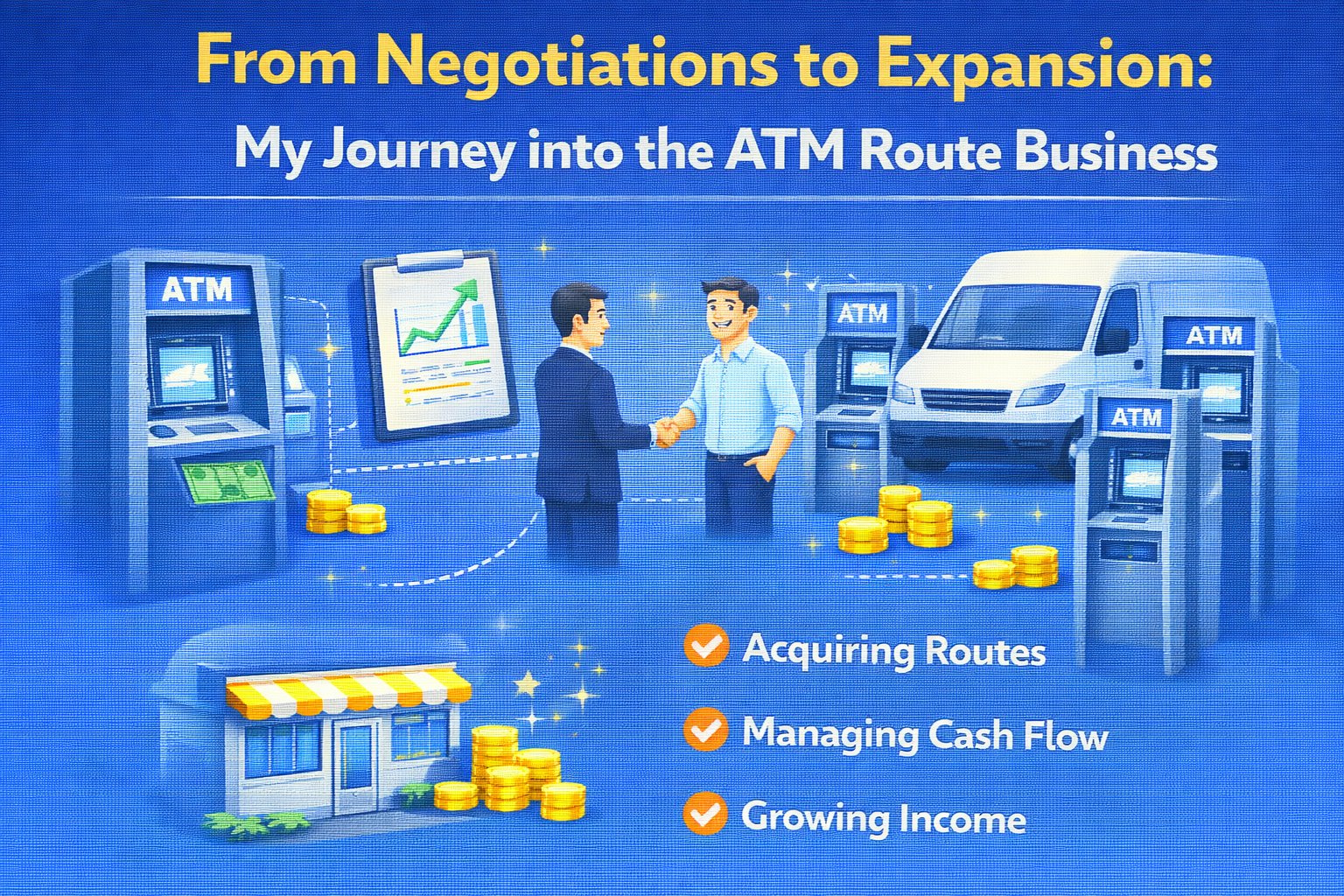
When most people think about building wealth, they imagine investing in stocks, real estate, or launching a high-growth startup. But another path exists—one that is often overlooked and surprisingly profitable:
owning small, cash-flowing machines placed in high-traffic locations.
One of the most interesting examples of this type of business is the ATM route business.
ATM routes fall into the category of what many entrepreneurs call “boring businesses.” They don’t generate headlines or viral attention, but they can produce steady income with relatively simple operations.
In this article, I’ll walk through the process of entering the ATM business—from evaluating opportunities and negotiating deals to expanding a route and building long-term cash flow.
What Is an ATM Route Business?
An ATM route business involves owning automated teller machines placed in locations such as:
-
convenience stores
-
gas stations
-
bars and restaurants
-
nightclubs
-
event venues
-
small retail shops
Every time a customer withdraws cash from the ATM, they pay a transaction fee, commonly called a surcharge.
A portion of that fee becomes revenue for the ATM operator.
The business model is straightforward:
-
Place machines in high-traffic locations
-
Keep machines stocked with cash
-
Earn revenue from withdrawal fees
Because the machines operate automatically, the business can generate income even when the owner is not actively working.
Why ATM Businesses Attract Entrepreneurs
ATM route businesses have several characteristics that appeal to investors and entrepreneurs.
Recurring Transaction Revenue
Each withdrawal produces a fee, often ranging from $2.50 to $4.00 depending on the location.
High-traffic machines can process hundreds or thousands of transactions each month.
Low Labor Requirements
Once machines are installed, the primary responsibilities include:
-
cash loading
-
maintenance
-
location management
Compared to many service businesses, labor requirements are relatively low.
Scalable Business Model
Adding more machines increases revenue potential.
As routes expand, operators can often manage multiple locations efficiently.
Asset Ownership
Each ATM machine is a physical asset that can produce income over time.
Machines can also be sold along with their locations if the business owner decides to exit the industry.
Finding an ATM Business Opportunity
Entrepreneurs interested in entering the ATM industry typically begin by either:
-
purchasing an existing ATM route
-
installing new machines in negotiated locations
Buying an existing route offers several advantages.
Existing routes often include:
-
established locations
-
historical transaction data
-
operational systems
This data helps buyers estimate potential revenue before making a purchase.
Evaluating an ATM Route Before Buying
Before acquiring an ATM business, it’s essential to analyze several factors.
Transaction Volume
The most important metric is the number of monthly withdrawals.
Higher transaction volume leads directly to higher revenue.
Location Quality
The success of an ATM depends heavily on location.
Ideal locations include businesses where customers frequently use cash.
Examples include:
-
bars and nightclubs
-
small grocery stores
-
casinos
-
entertainment venues
Locations that rely primarily on credit cards may generate fewer transactions.
Fee Structure
ATM operators earn money from withdrawal surcharges.
Understanding how fees are split between the operator and the location owner is critical.
In many cases, the business owner hosting the ATM receives a portion of the surcharge as an incentive.
Negotiating Location Agreements
Location agreements play a central role in ATM route profitability.
Operators typically negotiate terms with the business owner hosting the machine.
Agreements often include:
-
revenue sharing percentages
-
machine placement rights
-
maintenance responsibilities
-
contract duration
Strong negotiation skills can significantly impact the profitability of each ATM location.
Operational Responsibilities of an ATM Route Owner
Although ATM machines are automated, they still require regular oversight.
Key operational tasks include:
Cash Management
Machines must be stocked with cash regularly to ensure availability for customers.
Operators either supply their own cash or partner with financial institutions.
Machine Maintenance
Occasional maintenance is required to address:
-
receipt paper replacement
-
card reader cleaning
-
software updates
Reliable machines minimize downtime and lost revenue.
Monitoring Transactions
ATM operators track transactions to ensure machines are functioning properly and generating expected revenue.
Many modern machines provide remote monitoring systems.
Expanding an ATM Route
Once an entrepreneur successfully operates a few machines, expansion opportunities begin to appear.
Expansion strategies may include:
-
negotiating additional locations
-
purchasing additional machines
-
acquiring competing routes
-
partnering with local businesses
Scaling gradually allows operators to learn the business while increasing cash flow.
Financing ATM Route Growth
ATM route businesses can be expanded through several funding strategies.
Common approaches include:
-
reinvesting transaction profits
-
small business loans
-
partnerships with investors
-
seller financing when acquiring routes
Because ATM machines are physical assets that generate revenue, they can sometimes be financed similarly to equipment.
Risks and Challenges in the ATM Business
Like any business, ATM routes involve potential challenges.
Cash Security
Operators must safely transport and manage cash supplies.
Security protocols are essential.
Location Dependency
If a business hosting the ATM closes or relocates, transaction volume may disappear.
Diversifying locations helps reduce this risk.
Payment Trends
As digital payments become more popular, some industries may rely less on cash.
However, many industries—particularly nightlife and small retail—still depend heavily on cash transactions.
Why ATM Routes Fit the “Boring Business” Model
ATM routes exemplify the type of business many entrepreneurs overlook.
They are:
-
simple to understand
-
operationally straightforward
-
capable of producing recurring income
Unlike startups chasing rapid growth, ATM businesses focus on steady cash flow and long-term stability.
For investors seeking practical wealth-building opportunities, this model can be highly appealing.
Lessons from the ATM Route Journey
Entering the ATM business provides valuable lessons about entrepreneurship.
Cash Flow Matters More Than Hype
Businesses that generate consistent income often outperform trend-driven ventures.
Location Is Everything
High-quality locations determine whether an ATM succeeds or struggles.
Negotiation Skills Are Critical
Strong agreements with location owners can significantly increase profitability.
Growth Happens Through Systems
Once systems are in place, scaling the business becomes easier.
Final Thoughts
The ATM route business may not sound glamorous, but it represents an example of how simple systems can produce powerful financial results.
By identifying strong locations, negotiating smart agreements, and expanding strategically, entrepreneurs can build a business that generates recurring income.
For many investors, these types of “boring businesses” become the foundation of long-term wealth.
Sometimes the most powerful opportunities are the ones hiding in plain sight—quietly generating cash while others chase the next big trend.


Leave a Reply