
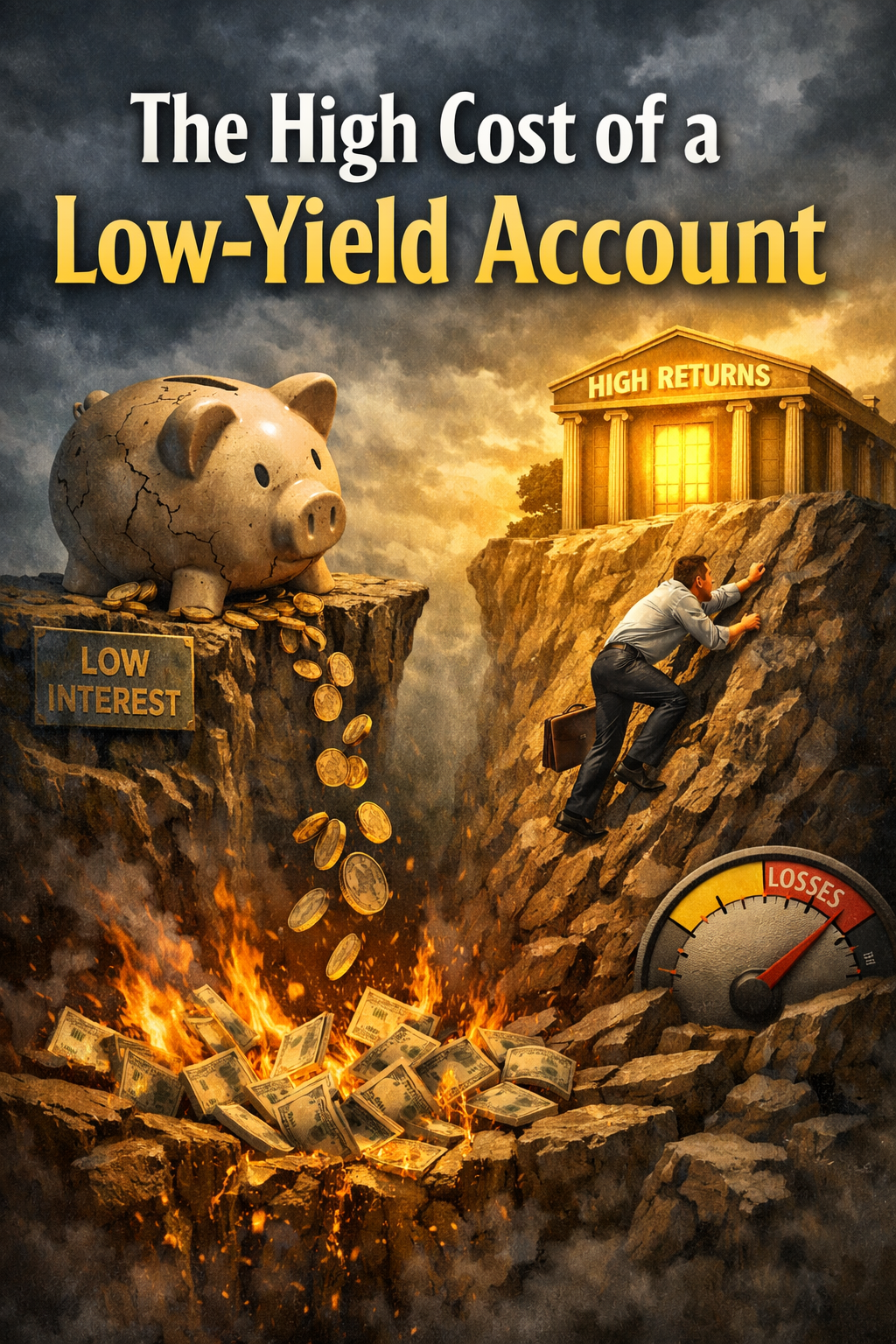
Most people believe that putting money into a savings account is the safest financial move they can make.
And technically, they’re right.
Savings accounts are safe, insured, and liquid.
But there is a hidden problem most people never calculate.
If your money is sitting in a low-yield savings account, it may actually be losing value every year.
Not because of fees.
Not because of market crashes.
But because of interest rates and inflation working against you.
This silent financial leak is costing millions of Americans hundreds or even thousands of dollars every year.
Let’s break down the real cost of a low-yield account — and how to fix it.
The Hidden Problem: Most Savings Accounts Pay Almost Nothing
Most traditional banks still pay extremely low interest on savings accounts.
The national average savings account rate in the United States is around 0.39% APY, according to FDIC data.
Meanwhile, many online high-yield savings accounts offer rates between 3% and 5% APY.
That difference may sound small — but it has a massive long-term impact.
Let’s look at a simple comparison.
| Account Type | Interest Rate | $20,000 After 1 Year |
|---|---|---|
| Traditional Bank | 0.39% | ~$78 earned |
| High-Yield Savings | 4% | ~$800 earned |
On the same money.
That’s over 10× more interest.
In fact, the best high-yield accounts today can reach around 5% APY, dramatically outperforming traditional banks.
The Real Enemy: Inflation
Low interest rates would already be a problem.
But inflation makes it even worse.
Inflation slowly reduces the purchasing power of your money over time.
For example:
If inflation is 2.4%, prices rise roughly that much each year.
If your savings account earns 0.39%, you’re losing money in real terms.
Your money grows slowly, but prices grow faster.
This creates what economists call a negative real return.
A simple example:
| Scenario | Result |
|---|---|
| Inflation | 3% |
| Savings Rate | 0.5% |
| Real Return | -2.5% |
In other words, even though your account balance rises slightly, your buying power falls.
The 10-Year Damage of a Low-Yield Account
The long-term impact is shocking.
If inflation averages 3% annually, a $10,000 balance today may only have the purchasing power of about $7,821 in 10 years if it earns very little interest.
That’s nearly 22% of your savings disappearing silently.
This is why financial experts emphasize that savings must earn interest that at least keeps pace with inflation.
Why Traditional Banks Pay So Little
Most large brick-and-mortar banks offer low interest rates because:
-
They have high operating costs (branches, employees, infrastructure).
-
They rely on customer inertia.
-
Many customers never compare interest rates.
Online banks operate differently.
They have:
-
Lower overhead
-
Fewer physical branches
-
Technology-driven operations
Because of this, they often offer significantly higher interest rates to attract deposits.
High-Yield Savings Accounts: The Modern Alternative
A high-yield savings account (HYSA) works exactly like a regular savings account but pays much higher interest.
Key features typically include:
-
FDIC insurance up to $250,000
-
Daily compound interest
-
Online access
-
No monthly fees
Rates typically range from 3% to 5% APY depending on market conditions.
Even modest balances benefit dramatically.
Example:
| Balance | 0.4% Interest | 4% Interest |
|---|---|---|
| $5,000 | $20/year | $200/year |
| $20,000 | $80/year | $800/year |
| $50,000 | $200/year | $2,000/year |
That difference compounds over time.
The Psychology of Low-Yield Accounts
Many people keep money in low-interest accounts simply because:
-
It’s the bank they’ve always used
-
It’s where their checking account is
-
They assume switching is complicated
But moving money to a higher-yield account is usually simple and takes less than 10 minutes online.
In many cases, you can:
-
Open an account online
-
Link your existing bank
-
Transfer funds electronically
That’s it.
Where You Should Keep Your Cash Instead
Not all money should be invested in the stock market.
Short-term money belongs in low-risk, liquid accounts.
Good options include:
1. High-Yield Savings Accounts
Best for:
-
Emergency funds
-
Short-term savings
-
General cash storage
2. Money Market Accounts
These are similar to savings accounts but may include:
-
Check writing
-
Debit card access
3. Treasury Bills
Government bonds with short durations that often offer competitive yields.
4. Certificates of Deposit (CDs)
Fixed-term deposits that may offer 4%–5% returns depending on term length.
Each option serves a slightly different purpose depending on your liquidity needs.
How to Tell if Your Savings Account Is Underperforming
Ask yourself three questions:
1. What is your APY?
If your account earns less than 2–3%, it’s likely underperforming.
2. Is your interest beating inflation?
If not, your money is shrinking in real terms.
3. Could you move it in 10 minutes?
If the answer is yes, there’s little reason to stay with a low-yield account.
The Smart Way to Structure Your Savings
A simple and effective system looks like this:
Checking Account
-
Monthly spending
-
Bills
High-Yield Savings Account
-
Emergency fund
-
Short-term savings
Investment Accounts
-
Long-term wealth building
-
Retirement
This structure keeps money accessible while still earning interest.
A Simple Rule for Smart Savers
Your savings should always be doing one of three things:
-
Earning interest
-
Protecting against inflation
-
Providing liquidity
If your savings account does none of those effectively, it’s costing you money.
Final Thoughts
A low-yield savings account may feel safe, but it carries an invisible cost.
Between tiny interest rates and inflation, your savings may be losing value every year.
The good news is the solution is simple.
Moving your money to a high-yield savings account or another interest-earning vehicle can dramatically increase your returns with virtually no additional risk.
Sometimes improving your finances isn’t about making more money.
It’s about stopping money from quietly leaking away.


Leave a Reply