
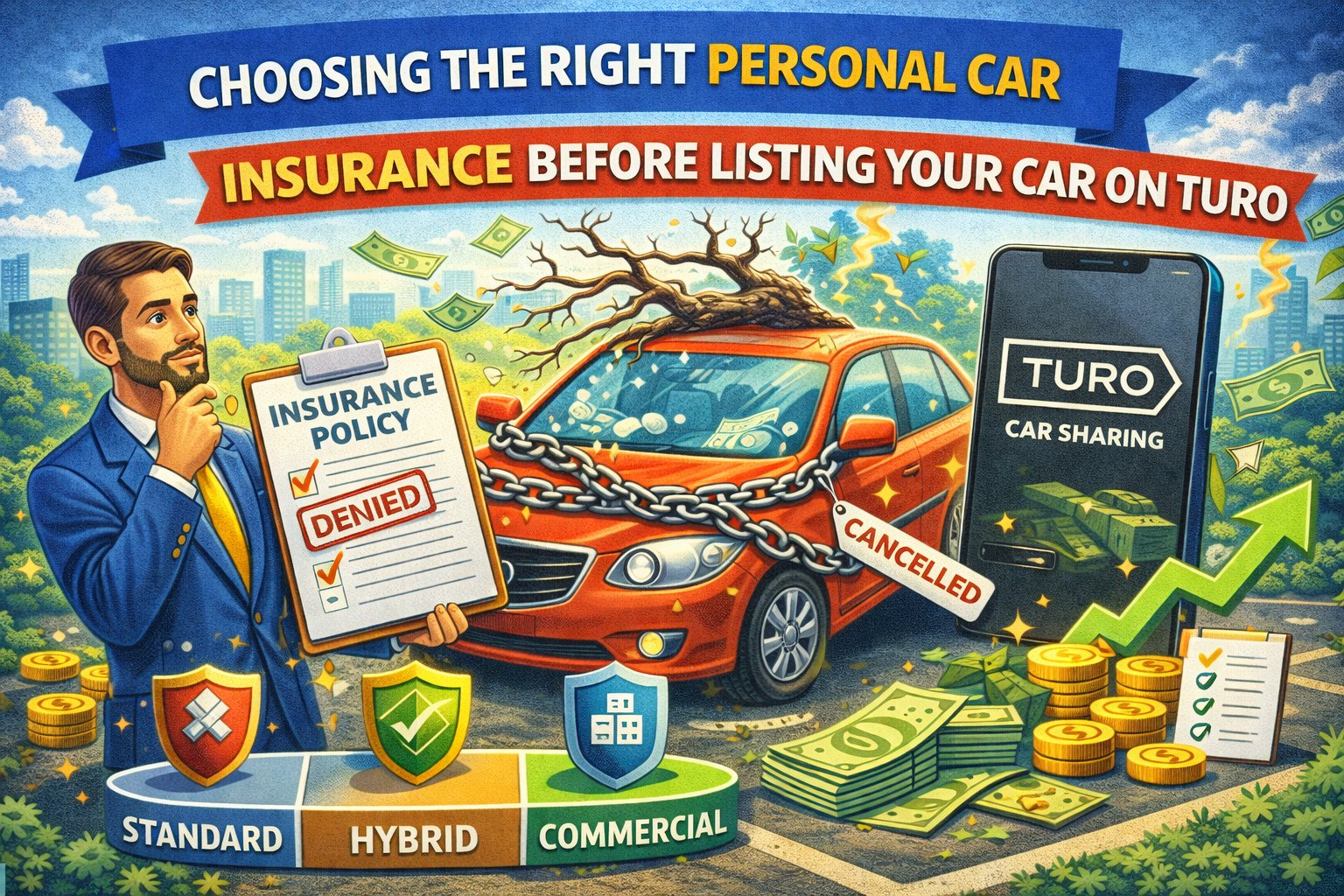
Many new Turo hosts make a common and risky assumption: they believe they’re fully protected without understanding how insurance works in the car-sharing business.
This misconception can lead to denied claims and, even worse, the cancellation of your insurance policy. Before you list your car for rent, it’s crucial to understand how your personal insurance policy impacts your car-sharing venture.
Proper preparation can help you avoid financial disasters later on. This guide will help you safeguard yourself before your first booking, ensuring you don’t have to learn these lessons the hard way after a claim arises.
First — Understand the Insurance Layers
When you list on Turo, three separate coverages exist:
-
Your personal auto insurance
-
Turo protection plan
-
Guest’s insurance (sometimes)
They do not replace each other; they activate at different times. The gaps between them are where hosts lose thousands.
The Critical Concept: Commercial Use Exclusion
Nearly all standard personal auto policies contain a clause similar to:
“Coverage is excluded when the vehicle is used for livery, rental, or commercial purposes.”
Car sharing qualifies as commercial use.
Meaning:
Your insurer can legally deny coverage even if the car isn’t rented — simply because it’s listed. This is why some hosts only realize their mistake after receiving cancellation letters upon renewal.
What Turo Actually Covers (And What It Doesn’t)
Turo protection plans protect during an active trip.
They generally cover:
-
Physical damage during the reservation
-
Liability during reservation
-
Theft during reservation
They do NOT cover:
-
Normal personal driving
-
Driving between bookings
-
Storage damage
-
Undisclosed commercial usage violations
-
Policy cancellation consequences
Turo protects the trip.
Your insurance protects your ownership.
The Three Types of Insurance You’ll Encounter
1) Standard Personal Insurance (Usually Not Enough)
Most major carriers prohibit peer-to-peer car sharing.
Common outcomes:
-
Claim denial
-
Policy cancellation
-
Non-renewal
-
Backdated underwriting action
The risk isn’t just accidents — it’s insurability.
2) Hybrid / Car-Sharing Friendly Policies (Best Starting Point)
Some insurers allow limited car-sharing activity with disclosure.
These are typically the safest entry option for new hosts because they:
-
Allow personal use
-
Allow off-rental storage coverage
-
Avoid cancellation risk
This is usually the minimum acceptable setup before listing.
3) Commercial Fleet Policies (Scaling Stage)
Once you operate multiple vehicles, a commercial policy becomes the cleanest structure.
Benefits:
-
Designed for rental risk
-
Stable underwriting
-
Easier claims handling
-
Business legitimacy
Downside:
Higher upfront cost but lower long-term risk.
The Most Overlooked Risk: Between-Trip Damage
New hosts worry about renters damaging the car.
Experienced hosts worry about parking lot damage.
Why?
Because Turo coverage only applies during a reservation.
If a tree branch falls on your car overnight or a neighbor hits it while parked — your personal policy must respond.
If your insurer disallows car-sharing, you may have no coverage at all.
How to Talk to Your Insurance Company (Correctly)
Do NOT ask:
“Can I rent my car on Turo?”
That often triggers an immediate underwriting flag.
Instead ask:
“Does my policy allow peer-to-peer car sharing activity, and what endorsements would be required?”
You want documentation — not verbal approval.
Always request confirmation in writing.
Choosing the Right Deductible Strategy
Your deductible should align with your Turo protection plan.
Example strategy:
| Turo Deductible | Personal Deductible | Reason |
|---|---|---|
| High | Low | Protects off-trip risk |
| Low | Medium | Balanced coverage |
| Very Low | Higher | Cash-flow optimized hosts |
Insurance isn’t just protection — it’s financial planning.
Financial Planning Perspective (The Part Most Hosts Ignore)
Insurance is not just a compliance task.
It determines:
-
profit stability
-
loan approval
-
scaling ability
-
business survivability
The cheapest policy often becomes the most expensive decision.
A single denied claim can erase months (or years) of hosting profit.
A Simple Pre-Listing Checklist
Before activating your listing:
-
Confirm car-sharing allowance in writing
-
Understand commercial exclusion wording
-
Match deductible to protection plan
-
Verify coverage between trips
-
Document agent confirmation
-
Budget insurance into pricing model
If one of these steps is missing — you don’t have a safe business yet.
When to Upgrade Insurance
Upgrade when:
-
You add a second vehicle
-
Bookings become consistent
-
Revenue exceeds payment + expenses
-
You rely on income
Insurance should evolve with your risk exposure.
Final Thoughts
Listing your car on Turo involves more than just renting it out. You are stepping into a regulated environment where careful attention to paperwork is essential.
The hosts who achieve long-term success are not necessarily those who never experience accidents; rather, they are the ones who effectively manage their insurance coverage to avoid gaps.
Prioritize your insurance, and it will transform every future booking into a predictable source of income rather than a financial gamble.


Leave a Reply