
Most budgets fail for one simple reason: they rely on motivation.
Many people track their expenses for two weeks, feel restricted by the process, and then stop. This isn’t due to a lack of discipline; rather, the system requires constant attention, which can be overwhelming.
That’s why modern personal finance advice, especially from behavioral finance experts like Ramit Sethi, moves away from strict budgeting and towards structured allocation. Instead of tracking every dollar spent, you can set up an automatic system that determines where your money goes.
The 50/30/20 rule is effective not because it’s flawless, but because it simplifies spending and saving decisions.
What the 50/30/20 Rule Actually Is
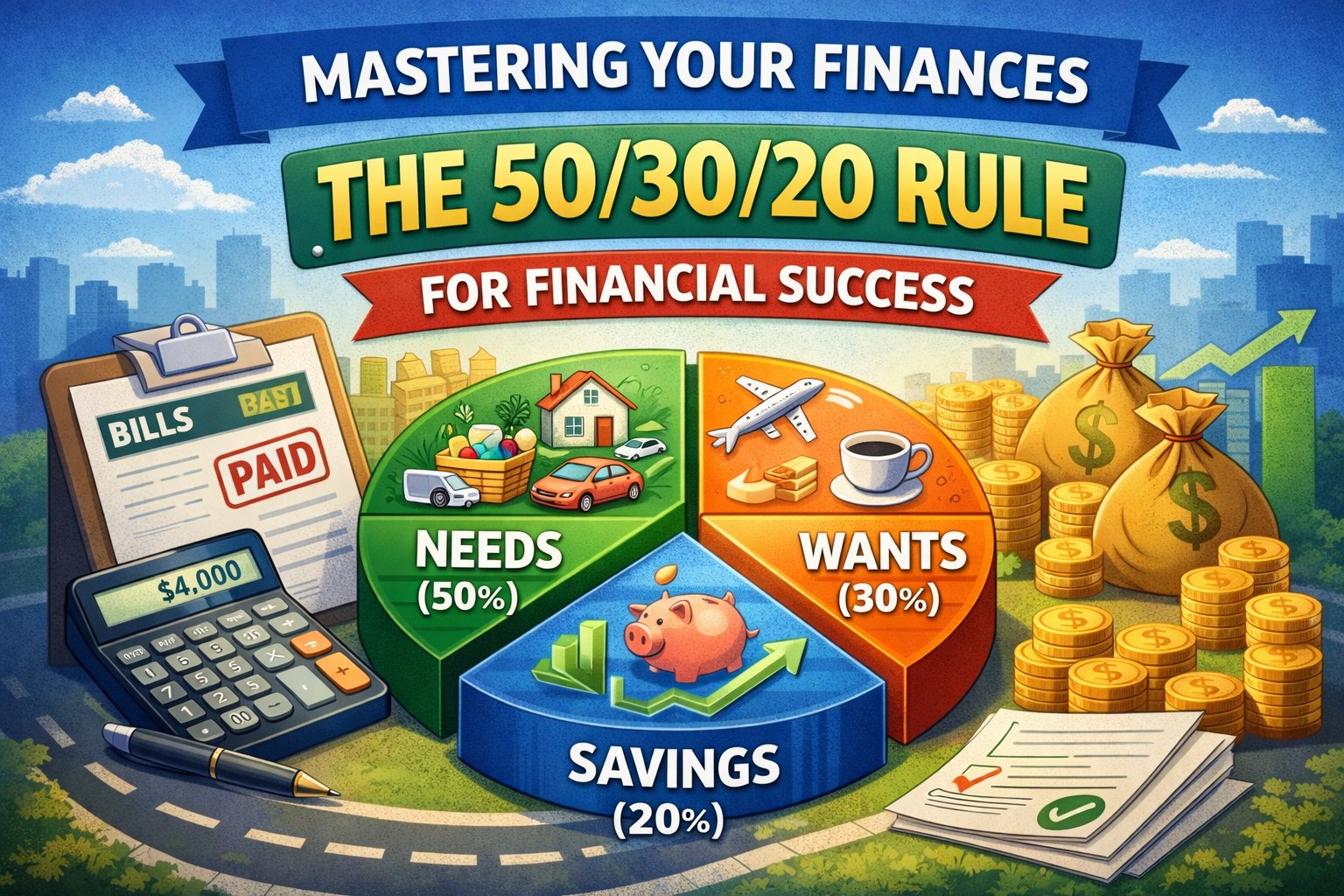
The rule divides your after-tax income into three categories:
-
50% → Needs
-
30% → Wants
-
20% → Savings & debt payoff
This framework assigns a purpose to every dollar without micromanaging your life. It functions more like a financial operating system than a strict budget—serving as a default setting for your money.
Why This Rule Works Psychologically
Traditional budgeting says:
Spend less.
But behavioral finance shows:
Humans don’t change habits through restriction — they change through structure.
Ramit Sethi’s approach emphasizes systems and automation over willpower. His philosophy: build a “Rich Life” where spending and saving happen intentionally, not reactively.
The 50/30/20 rule works because it removes daily decision-making.
You stop asking:
-
“Can I afford this?” And start knowing:
-
“My system already decided.”
Breaking Down the Three Categories
1) The 50% — Needs (Survival Expenses)
Needs are non-negotiables:
-
Housing
-
Utilities
-
Insurance
-
Groceries
-
Minimum debt payments
-
Transportation
They are mandatory costs for functioning.
If your needs exceed 50%, your financial stress won’t be solved by budgeting — it must be solved by:
-
lowering fixed costs
-
increasing income
-
restructuring debt
This is why many people feel “bad with money” when the real issue is a structural cash-flow imbalance.
2) The 30% — Wants (Quality of Life Spending)
This category is misunderstood.
It is not wasteful spending.
It is intentional enjoyment:
-
Dining out
-
Travel
-
Hobbies
-
Entertainment
-
Subscriptions
The rule explicitly allows spending because deprivation-based budgeting fails in the long term.
Ramit Sethi’s philosophy aligns strongly here: spend generously on what you love while cutting ruthlessly on what you don’t.
This prevents the “budget binge cycle”:
restriction → burnout → overspending
3) The 20% — Savings & Wealth Building
This includes:
-
Emergency fund
-
Retirement accounts
-
Investments
-
Extra debt payments
The rule promotes consistent wealth building rather than sporadic saving.
Sethi recommends automatic transfers so saving happens without effort — the cornerstone of long-term financial success.
The Hidden Principle: Automation Beats Discipline
Many people attempt to save their leftovers, both in food and finances. However, the 50/30/20 rule suggests a different approach: prioritize saving first and then use the remaining funds for living expenses.
Automating your financial processes tends to be more effective than relying solely on motivation, as motivation can vary greatly.
This is why individuals who automate their finances typically accumulate wealth more quickly than those who depend on manual financial decisions.
Example Monthly Breakdown
Consider a take-home income of $4,000:
| Category | Amount | Purpose |
|---|---|---|
| Needs (50%) | $2,000 | Bills & essentials |
| Wants (30%) | $1,200 | Lifestyle spending |
| Savings (20%) | $800 | Investing & future |
You never have to question where your money went; it was already allocated.
How Ramit Sethi’s “Conscious Spending Plan” Refines It
Ramit Sethi adapts the idea into four flexible buckets:
-
Fixed Costs ~50–60%
-
Investments ~10%
-
Savings ~5–10%
-
Guilt-Free Spending ~20–35%
The percentages vary — but the structure remains intentional allocation over tracking.
The lesson:
The exact numbers matter less than the predictable system.
When the Rule Doesn’t Fit (And What to Do)
In high-cost areas, many households spend over 50% of their income on essential expenses.
This spending doesn’t indicate failure; instead, it calls for adjusting financial ratios while maintaining overall structure. Financial planners often modify these percentages based on living costs and individual life stages.
Even with these adjustments, the core principle remains the same: allocate resources intentionally and automate the process consistently.
The Real Goal: Financial Calm
People think budgeting is about restriction.
It’s actually about removing uncertainty.
The 50/30/20 framework creates:
-
Predictability
-
Reduced financial anxiety
-
Clear spending permission
-
Automatic wealth building
When your system works, you stop obsessing over money — and start using money to support life.
Step-by-Step Implementation Plan
Step 1 — Calculate your take-home pay
Use monthly after-tax income only.
Step 2 — List fixed expenses
Identify essentials first (housing, insurance, debt minimums).
Step 3 — Automate savings immediately
Set transfers to savings/investments before spending.
Step 4 — Assign guilt-free spending
The remaining discretionary money becomes safe to spend.
Step 5 — Review quarterly
Adjust categories, not daily behavior.
Final Thoughts
Financial success often does not stem from being excessively frugal. Instead, it arises from consistent systems that have been applied over many years.
The 50/30/20 rule is effective because it makes financial decisions routine. Once money management becomes automatic, accumulating wealth shifts from being an objective to simply a byproduct of good habits.


Leave a Reply