
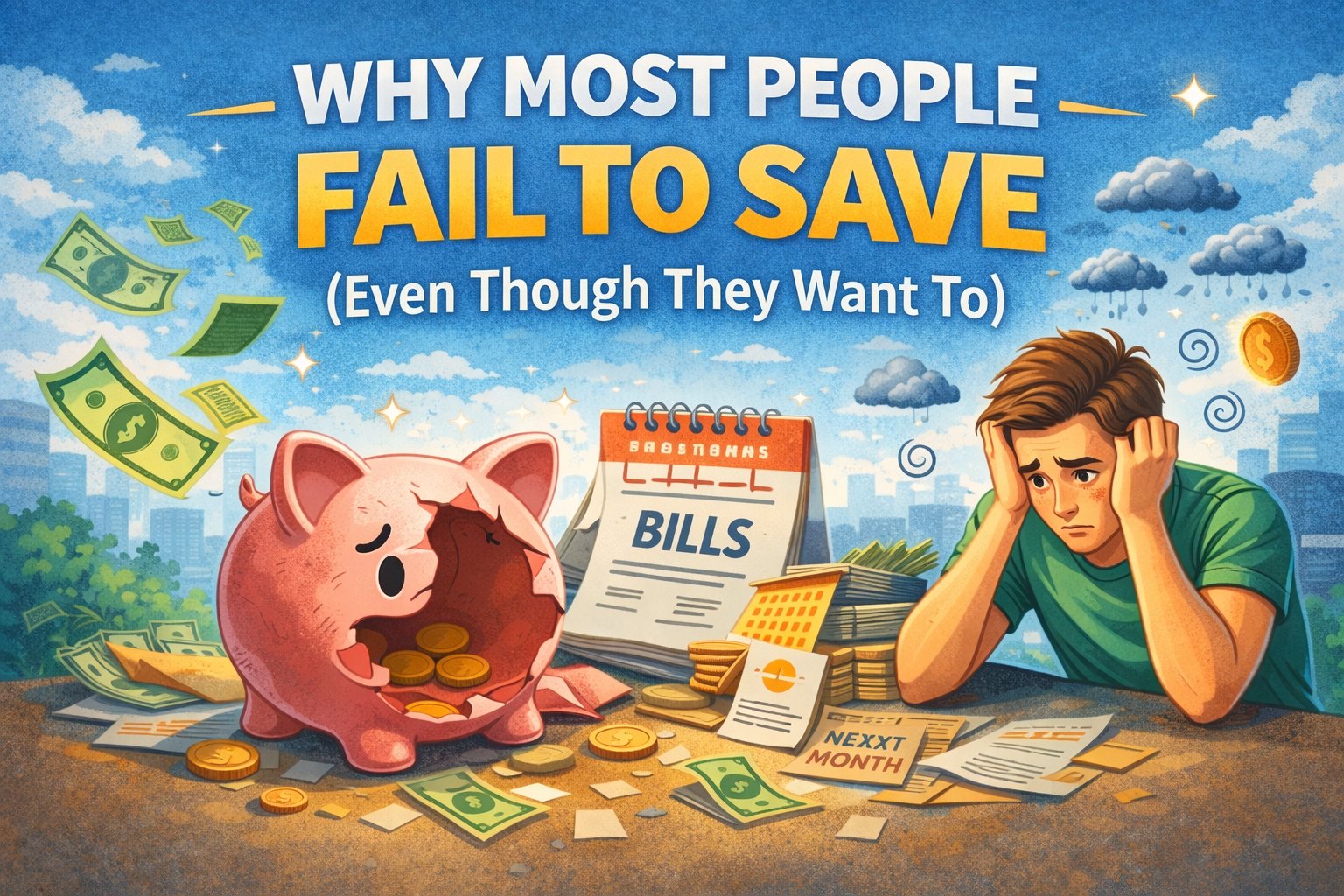
Almost everyone wants to save money.
They talk about it, plan for it, and promise themselves they’ll start “next month.” Yet, year after year, their savings accounts barely change—or, worse, remain empty.
This disconnect isn’t about intelligence, discipline, or desire; it’s about how saving is structured in most people’s lives. People don’t fail to save because they’re careless.
They struggle because the systems they’re using are fundamentally flawed. Let’s explore the real reasons why saving feels so challenging and why even motivated, responsible individuals have trouble making progress.
1. Saving Is Treated Like an Option, Not a Requirement
Bills are non-negotiable. Rent, utilities, phone plans, and subscriptions get paid automatically. However, saving is often seen as something to do only if there’s money left over. Unfortunately, there almost never is.
When saving isn’t viewed as a fixed obligation, it gets pushed to the bottom of the priority list. Life always finds a way to spend whatever money is available.
People who successfully save change their approach: they prioritize saving first, and then adapt their spending afterward.

2. Most People Don’t Know Where Their Money Is Actually Going
Ask someone how much they spent last month, and most can’t tell you—at least not accurately.
Money leaks quietly through:
-
Subscriptions that go unused
-
Small daily purchases
-
Convenience spending
-
“Just this once” expenses
Without visibility, saving feels impossible because it seems like there’s nothing to cut—when in reality, money is escaping unnoticed.
Clarity alone doesn’t solve everything, but without it, saving is guesswork.
3. Motivation Is Doing All the Work (and That’s a Problem)
Motivation is emotional. It fluctuates.
Saving systems that rely on motivation require you to:
-
Remember to transfer money
-
Resist impulse spending
-
Constantly make “good” decisions
That’s exhausting.
People who save consistently remove decision-making from the equation. Automation turns saving into a background process—quiet, predictable, and reliable.
If saving requires constant effort, it won’t last.
4. Lifestyle Creep Consumes Every Raise
One of the biggest myths in personal finance is that earning more money automatically leads to saving more.
In reality, higher income often means:
-
Upgraded housing
-
Better cars
-
More subscriptions
-
More “convenience” spending
Raises feel like progress—but without boundaries, they simply raise the cost of your lifestyle.
Savings only increase when income growth is intentionally captured instead of automatically spent.
5. Saving Without a Clear Purpose Feels Like Punishment
“Save money” is vague and uninspiring.
“Build a $10,000 emergency fund so I never panic over unexpected bills” is powerful.
When saving has no emotional anchor, it feels like restriction. When it has a purpose, it feels like progress.
Most people fail to save because they haven’t defined what their savings is protecting or enabling.
6. The Wrong Accounts Kill Momentum
Saving money in low-interest accounts feels unrewarding.
When balances barely grow, saving feels pointless—especially compared to spending, which delivers instant gratification.
High-yield savings accounts change the psychology:
-
Interest becomes visible
-
Progress feels tangible
-
Consistency feels rewarded
Momentum matters more than people realize. When saving feels stagnant, people stop.
7. People Underestimate the Power of Small Wins
Many people believe saving only counts if it’s “a lot.”
So they wait—until income increases, expenses drop, or life becomes more stable. That moment rarely arrives.
In reality, consistency matters far more than amount.
Small, repeated actions:
-
Build confidence
-
Create habits
-
Reduce financial anxiety
Most people quit before these benefits compound.
8. Budgeting Is Misunderstood as Restriction
Budgeting has a branding problem.
People associate it with deprivation, guilt, and constant “no’s.” As a result, they avoid it entirely—or rebel against it quickly.
A good budget doesn’t restrict freedom. It directs money toward what actually matters.
When budgets feel punitive, saving feels like sacrifice. When they feel intentional, saving feels empowering.
9. One Emergency Can Undo Months of Progress
Without a buffer, saving is fragile.
A single unexpected expense—a car repair, medical bill, or urgent travel—can erase months of effort. When that happens repeatedly, people give up.
Emergency funds aren’t about optimization. They’re about stability.
Stability builds confidence. Confidence creates consistency.
10. No One Taught Them How Money Really Works
Most people were never taught:
-
How cash flow actually functions
-
How habits compound over time
-
How systems outperform discipline
-
How to align money with values
Instead, they learn through trial, error, and stress.
Saving isn’t intuitive. It’s a learned skill—and many people are navigating it without a map.
The Deeper Truth: Saving Fails Because Systems Fail
People blame themselves for not saving when the real issue is poor design.
A weak system makes good behavior hard.
A strong system makes it automatic.
When saving depends on memory, emotion, or perfect decision-making, it collapses under real life.
What Actually Works (And Why)
People who save successfully do a few things differently:
-
They automate before spending
-
They define clear goals
-
They reduce friction
-
They build buffers first
-
They reward consistency, not perfection
Saving becomes sustainable when it’s boring, predictable, and aligned with real life.
Final Thought
If you have struggled to save, it’s not due to a lack of discipline. It’s because you were taught to depend on willpower in a world designed to deplete it. Fixing the system makes saving feel easier.


Leave a Reply