
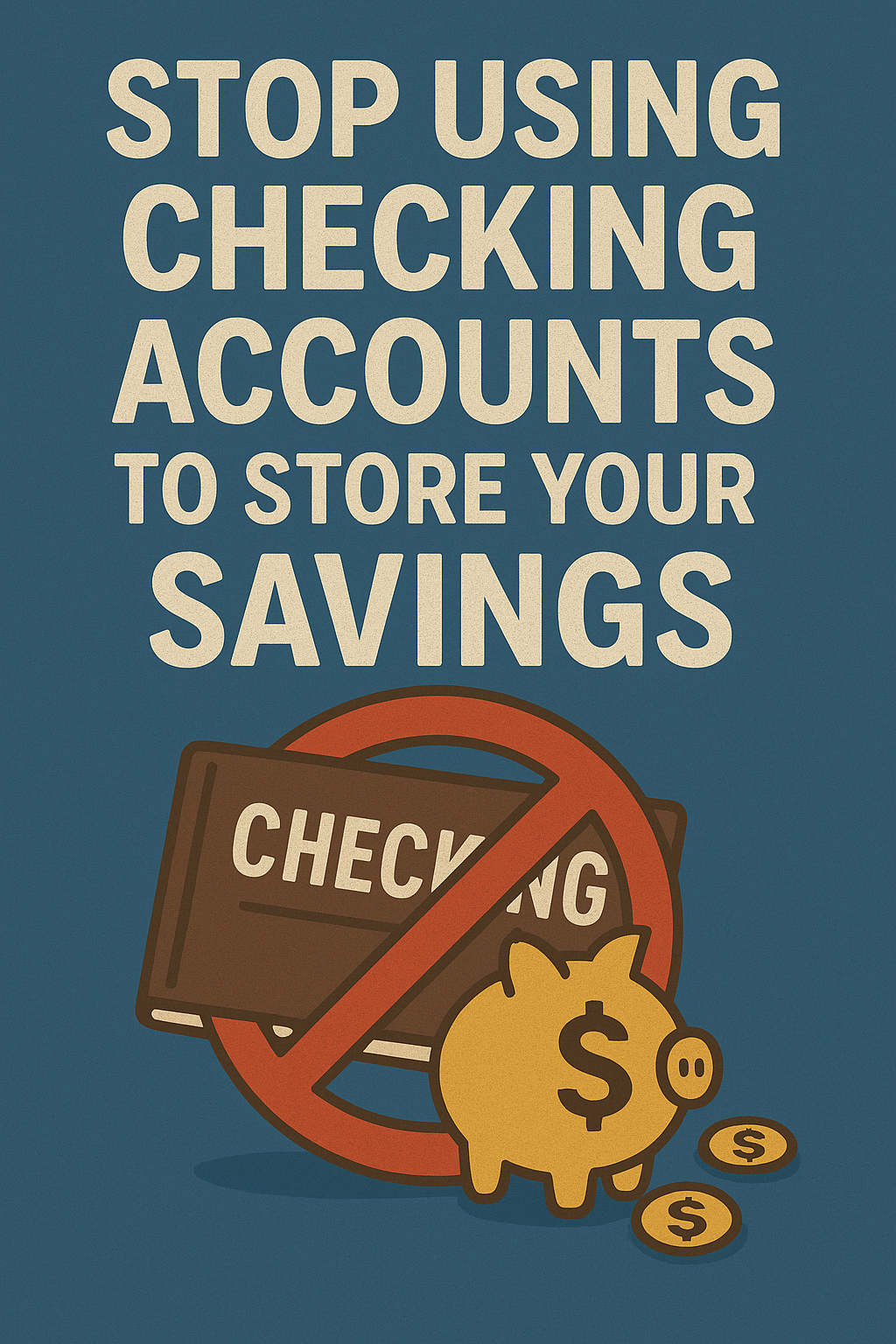
Why misplacing your savings is quietly costing you and how to fix it in under 10 minutes
Most people believe that as long as their money is sitting somewhere and not being spent, they’re being “responsible.” But responsibility is not the same as optimization. If you are storing your savings in your checking account, you’re not just making a bad financial move—you’re actively losing purchasing power every day.
Your checking account is not a savings strategy. It’s a financial highway. Money should flow through it, not live in it.
Here’s the truth most people miss:
| Account Type | Purpose | Impact on Wealth |
|---|---|---|
| Checking | Convenience and transactions | No growth |
| Traditional Savings | Basic security | Minimal growth (~0.1%) |
| High-Yield Savings (HYSA) | Security + compounding returns | Real growth (~4–5% APY) |
The objective isn’t to save money—it’s to place money where it grows.
In this expanded 1500-word deep dive, you’ll learn:
-
Why storing savings in checking creates hidden financial risk
-
How even small balances could cost you thousands over time
-
The fundamental difference between checking, traditional savings, and HYSA
-
How to effortlessly move money into a high-growth environment
-
How to set this up in under 10 minutes without changing your bank
The Problem: Convenience is killing your compounding potential
Keeping money in a checking account feels safe. It’s accessible. Familiar. That’s the illusion.
The reality:
-
It earns 0% interest
-
It keeps you mentally tied to spending
-
It makes budgeting more confusing
-
It blocks compounding, the core driver of long-term wealth
Imagine $10,000 sitting in your checking account for 24 months. You earn nothing from it. During that same period, inflation (currently hovering around 3–4%) erodes its buying power.
Now contrast it with putting that same money in a 4.5% HYSA:
| Balance | Checking (No interest) | HYSA @ 4.5% | Annual Difference |
|---|---|---|---|
| $5,000 | $5,000 | $5,225 | +$225 |
| $10,000 | $10,000 | $10,450 | +$450 |
| $25,000 | $25,000 | $26,125 | +$1,125 |
| $50,000 | $50,000 | $52,250 | +$2,250 |
That’s real money you’re losing every year—without any action taken. The cost of inaction is loss.
The Golden Rule
“Checking is designed for movement. Savings is designed for protection. High-yield savings is designed for growth.”
Most people combine the first two and completely ignore the third.
Why traditional banks aren’t helping you
Traditional banks have high overhead, physical branches, and outdated systems. They offer 0.1% APY or less on savings accounts, so they can keep profit margins high.
Meanwhile, digital-first banks like Wealthfront and SoFi operate leaner, enabling them to offer APYs of 4–5%.
The result? With modern high-yield options:
-
You earn up to 50x more than you would with traditional banks.
-
Your money remains FDIC-insured (up to $250K).
-
Transfers are easy and often instantaneous.
Let’s break it down clearly
The Functional Difference
| Feature | Checking Account | Traditional Savings | High-Yield Savings (HYSA) |
|---|---|---|---|
| Primary Purpose | Transactions | Safety | Growth & Compounding |
| Typical APY | 0% | 0.01–0.1% | 4–5% |
| Compounding | None | Minimal | High |
| Ease of Spending | High | Medium | Medium-low (by design) |
| Ideal Use | Everyday use | Short-term cushion | Ready resources that grow |
If you’re using your checking account as a pseudo savings account, you’re combining the worst attributes of the first two columns.
Behavioral finance insight: Why this mistake keeps happening
You might be thinking:
“Having extra money in checking makes me feel secure.”
It feels like control. But in reality:
-
It increases spending temptation
-
It causes blurred financial boundaries
-
It creates habitual overspending and under-saving
When money lives in a checking account, it’s mentally available. Smart savers intentionally make savings slightly less accessible, forcing thoughtful decisions before withdrawals.
This friction is beneficial.
The 3-Account Method (used by high performers)
This structure creates clarity:
Optional add-on:
Quick Decision Test
If you ever say this about your savings:
“I like to see my savings in checking so I know it’s there.”
That’s a sign you’re mixing psychological safety with financial misplacement.
Mini Calculator: How much are you losing waiting?
Use this formula:
Example:
That’s the equivalent of:
-
A weekend getaway every year
-
1 month of groceries
-
1–2 car payments
-
Or most importantly, money that could compound further
The 3-Step System to Fix This in Under 10 Minutes
-
Open a HYSA (Wealthfront, SoFi, Capital One 360)
– Requires SSN, bank routing, and ID if first use. -
Link your checking account
– Standard process takes 2 minutes. -
Transfer what does not need to be spent this month
– Leave only essential spending funds in checking.
– Optional: set automated transfers moving forward.
Total Time: 7–10 minutes
Long-term impact: Billions have been made from this strategy over decades.
Real Example: What $20,000 does in checking vs HYSA over 10 years
| Location | Interest Rate | Future Value |
|---|---|---|
| Checking | 0% | $20,000 |
| Traditional Savings | 0.01–0.1% | ~$20,200 |
| HYSA (4.5%) | ~$31,100 | |
| HYSA (5%) | ~$32,600 |
Cost of staying in checking? $11,000–$12,500+ in lost earnings.
Common Objections and Responses
| “But I want quick access.” | HYSAs allow instant transfers. |
|---|---|
| “What if I need cash fast?” | Move only what’s not for this month. |
| “Is it risky?” | Most are FDIC insured. Just like large banks. |
| “Will this affect my main banking?” | No. Checking stays unaffected. |
| “Is the setup complicated?” | If you can order something online, you can set this up. |
Best HYSAs for Smart Savers
| Provider | APY Range | Best For |
|---|---|---|
| Wealthfront | 4.75%–5.00% | Automation + effortless investing pathway |
| SoFi | ~4.60% | Rewards, direct deposit benefits |
| Capital One 360 | ~4.35% | Integration with existing accounts |
| Ally | ~4.25% | Long-standing reliability |
All are FDIC insured. All support automated transfers.
Behavior-Driven Strategy: Put friction on spending, not saving
Smart financial systems don’t require willpower.
Here’s how to implement friction correctly:
-
Checking → Immediate access
-
HYSA → Slight delay (ideal)
-
Long-term accounts → Harder access
If you need money quickly in a real emergency, HYSA gives it. But impulse withdrawals become harder.
That tiny barrier is what protects your future.
The Smart Money Flow
Treat excess checking balance as misallocated capital.
Why this matters now (not “sometime soon”)
Many people wait until they:
-
Earn more income
-
Get a bonus or raise
But here’s the truth:
If you aren’t managing your money properly when you earn less, you won’t change that when you earn more.
Optimization is about flow, not amount.
You don’t need a new financial app. You don’t need a stricter budget.
You just need to stop storing your savings in the wrong account.
Checking → convenience.
Savings → security.
High-Yield Savings → growth.
That’s the blueprint of smart money allocation.
👉 See how to set this up in under 10 minutes.
I’ll show you:
-
Which high-yield account to choose
-
The exact automation setup
-
How much to leave in checking
-
How to calculate ideal transfer amounts
Your money shouldn’t just be held—it should be earning.
Stop parking it. Start growing it.
Take 10 minutes today. Your future self will thank you every year for the rest of your life.


Leave a Reply