
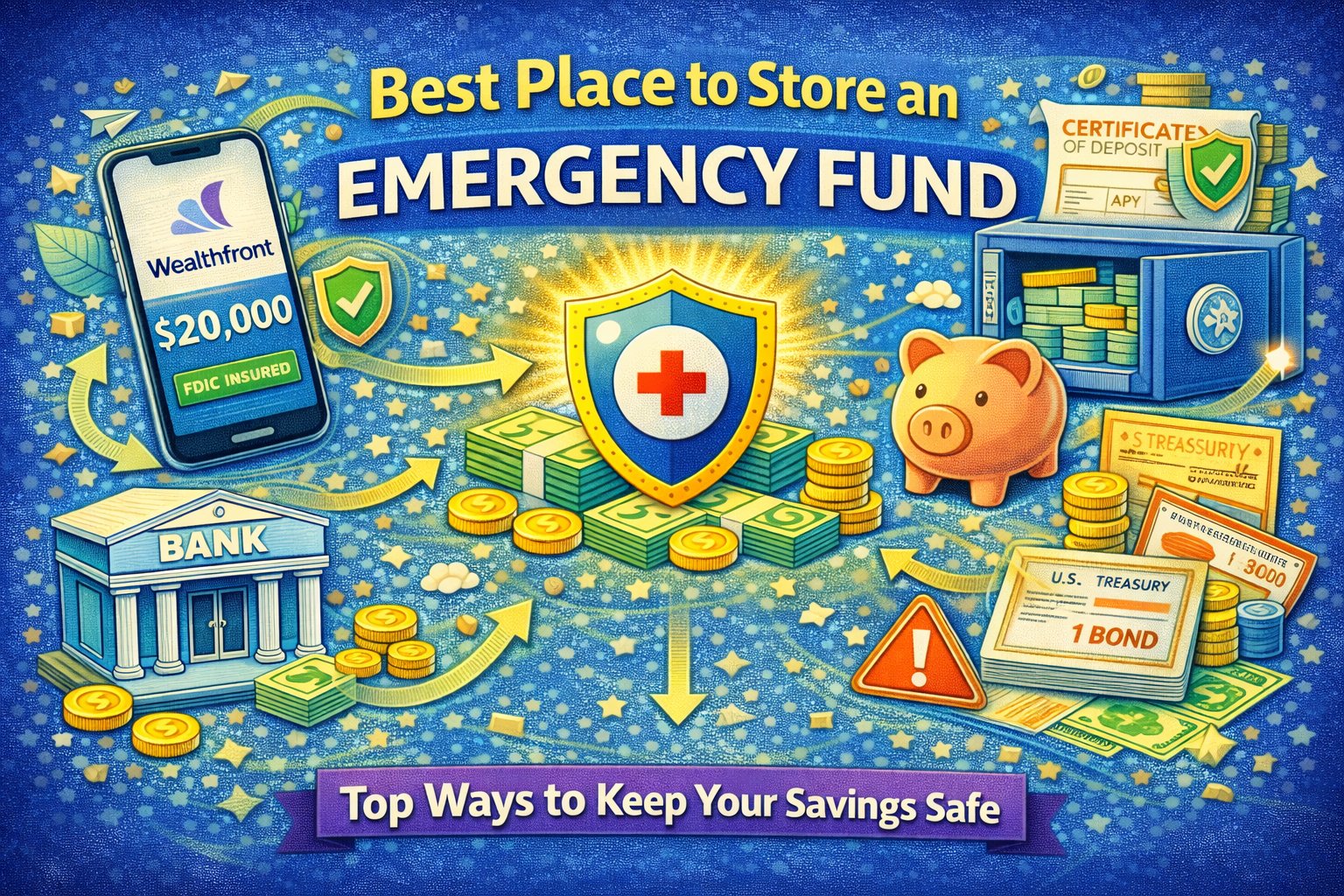
An emergency fund has only one purpose:
Be available when life goes wrong.
Not investing.
Not maximizing returns.
Not timing markets.
Just reliable access while preserving purchasing power.
Most people don’t fail at building an emergency fund because they don’t understand money —
they fail because they store it in the wrong place.
This guide focuses on where emergency money should actually live in 2026, based on how modern accounts work today.
What an Emergency Fund Must Do
A proper emergency reserve must satisfy four conditions simultaneously:
| Requirement | Why It Matters |
|---|---|
| Immediate liquidity | You can’t wait days during a crisis |
| No market risk | The balance must not fluctuate |
| Inflation resistance | Cash shouldn’t quietly shrink |
| Separation from spending | Prevent accidental use |
If any one of these fails, the fund stops functioning as insurance.
This is why the decision matters more than the amount.
Why Many People Store Emergency Funds Incorrectly
The biggest mistake is treating emergency money like regular money.
Emergency savings is not part of your monthly financial workflow —
it’s a contingency layer.
If it lives inside your daily spending environment, behavior erodes it.
Bad Places to Store an Emergency Fund
1) Checking Account
Problem: visibility equals spendability
When emergency cash sits next to bill-pay money, the brain categorizes it as available.
Over time it slowly disappears:
-
Unexpected purchases
-
Short-term wants
-
“I’ll replace it later” decisions
The issue is psychological, not mathematical.
2) Cash at Home
Feels safe.
Actually loses value constantly.
Inflation quietly reduces purchasing power every year.
Physical cash guarantees a negative real return.
Additionally:
-
Theft risk
-
Disaster risk
-
No recovery protection
Cash is liquid — but not protected.
3) Stock Market
This is the most dangerous mistake.
An emergency fund exists specifically for economic stress periods —
the exact time markets often decline.
If a job loss happens during a recession, investments may be down when needed most.
Emergency money must not depend on timing.
Good Places to Store an Emergency Fund
1) High-Yield Savings Accounts
These are the modern baseline.
They provide:
-
FDIC protection
-
Stable balance
-
Predictable interest
-
Easy transfers
This makes them appropriate for people who want a simple, traditional structure.
However, they still require manual discipline — you must avoid dipping into the balance.
2) Cash Management Accounts (Often Better)
Newer platforms improve on traditional savings by adding separation and automation.
They typically provide:
-
Competitive yield
-
Transfer rules
-
Savings categories
-
Behavioral separation
You can see a real structural example here:
https://thedigitalincome.com/comprehensive-review-of-wealthfronts-cash-account/
Instead of sitting beside spending money, the fund sits in its own layer.
That dramatically increases survival rate over time.
Why Separation Matters More Than Yield
People assume emergency funds fail because of low interest.
They actually fail because of accessibility.
If funds feel available, they get used.
If funds feel assigned, they remain intact.
So the ideal account is not the one with the highest APY —
it’s the one that prevents casual interaction.
The Ideal Emergency Fund Structure
Think of finances as three layers:
| Layer | Purpose |
|---|---|
| Checking | Monthly spending |
| Cash account | Emergencies & short-term reserves |
| Investments | Long-term growth |
Each layer solves a different problem.
When combined into one account, discipline becomes required.
When separated, discipline becomes automatic.
How Much Should You Keep?
General guidance:
-
Minimum: 1 month expenses (starter buffer)
-
Standard: 3–6 months expenses
-
Variable income / self-employed: 6–12 months
The more unpredictable your income, the more valuable liquidity becomes.
Inflation vs Safety — The Balance
Emergency funds should not chase returns.
But they should avoid decay.
The goal is:
Preserve purchasing power without introducing risk.
Modern high-yield accounts accomplish this by offsetting a portion of inflation while keeping stability.
Perfect inflation protection requires investment — which contradicts the purpose of an emergency reserve.
Common Mistake: Investing the Emergency Fund
Many people feel uncomfortable seeing idle cash.
So they invest it.
This works until the exact moment it matters.
Emergency funds are not inefficient —
they are financial shock absorbers.
You only notice their value when something breaks.
Final Recommendation
The best emergency fund location in 2026 is:
A separate high-yield cash account outside your daily spending bank.
Not hidden at home.
Not invested.
Not mixed with bills.
Separated, protected, and immediately accessible.
You can see how that structure works in practice here:
https://thedigitalincome.com/comprehensive-review-of-wealthfronts-cash-account/
Because the goal isn’t just storing money —
it’s preserving it until the day you truly need it.


Leave a Reply