
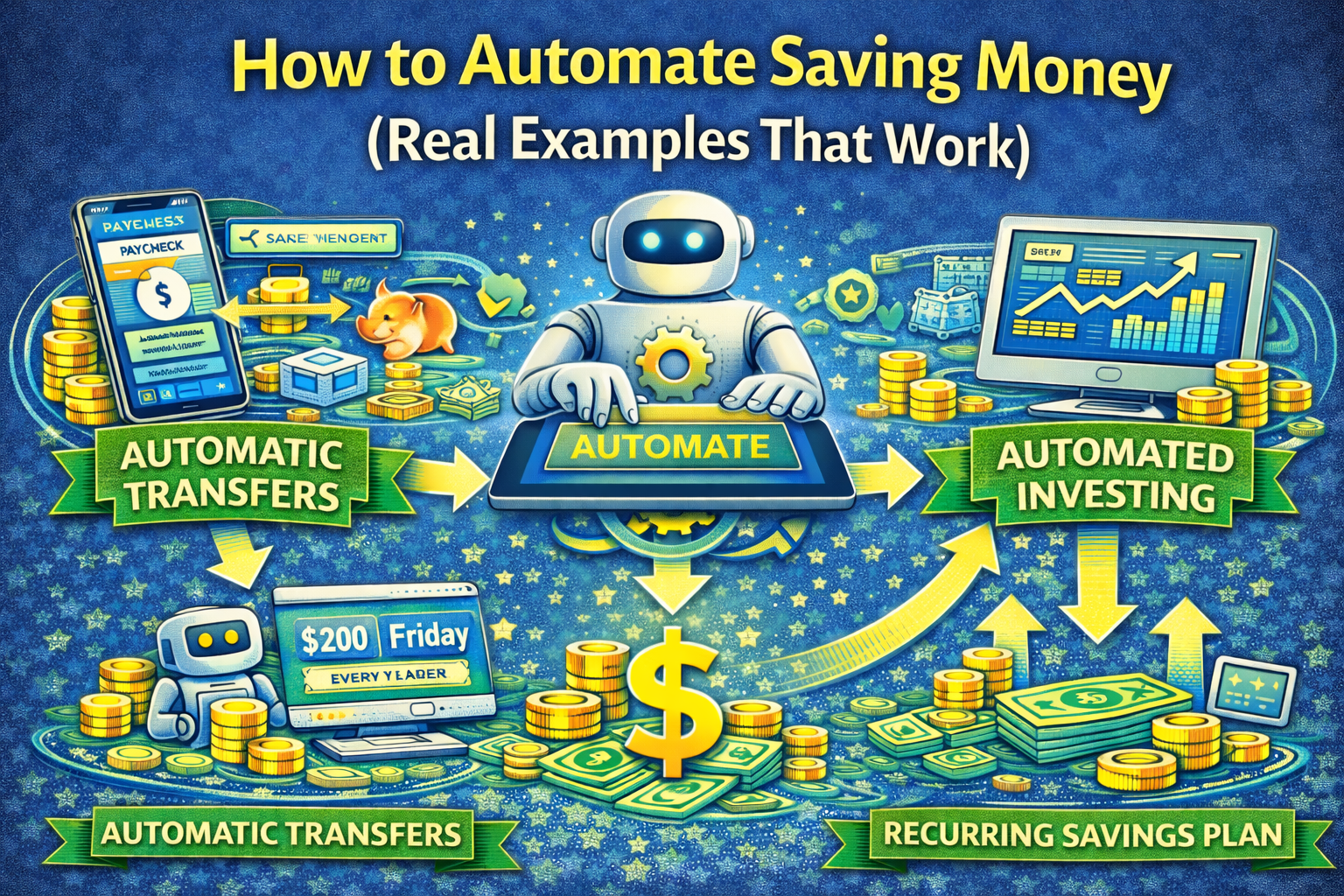
Most people don’t fail to save because they lack knowledge.
They fail because saving requires repeated decisions.
Every pay period creates the same internal negotiation:
Should I save this now… or after expenses?
Automation removes the negotiation entirely.
Instead of relying on motivation, you rely on structure — and structure is far more reliable over long time horizons.
The Psychology Behind Automation
There are two ways to manage money:
| Approach | What It Depends On | Long-Term Result |
|---|---|---|
| Manual saving | Discipline & memory | Inconsistent |
| Automated saving | System design | Predictable |
Humans are good at planning but inconsistent at repetition.
Systems are bad at planning but perfect at repetition.
Financial progress rewards repetition.
Method 1 — Pay Yourself First
This is the foundational automation rule.
Instead of saving what remains after spending:
You spend what remains after saving.
How To Set It Up
Schedule a transfer on payday:
Paycheck arrives → money immediately moves to savings
The key is timing — the transfer happens before spending decisions occur.
Why It Works
People rarely miss money they never mentally received.
By removing the cash from your visible balance, your brain adapts spending downward automatically.
This single change often improves saving consistency more than budgeting apps.
Method 2 — Category Accounts (Behavior Separation)
The next level is dividing savings by purpose.
Instead of one general savings account, create multiple allocations:
-
Bills reserve
-
Emergency fund
-
Short-term goals
-
Long-term reserves
This transforms money from available to assigned.
You can see a real implementation example here:
https://thedigitalincome.com/comprehensive-review-of-wealthfronts-cash-account/
Behavioral Effect
General savings → feels spendable
Categorized savings → feels committed
People protect labeled money more than unlabeled money.
Method 3 — Threshold Transfers (Smart Overflow System)
This is one of the most effective but underused strategies.
Instead of fixed saving amounts, you automate based on balance levels.
Example Rule
If checking balance exceeds $2,000 → move excess to savings
This creates a financial “pressure valve.”
Benefits
-
Prevents silent spending creep
-
Captures irregular income
-
Adjusts automatically to lifestyle changes
You save more during high-income periods and maintain stability during low-income periods — without changing behavior.
Method 4 — Percentage-Based Automation
Another powerful variation:
Save a percentage instead of a fixed number.
Example:
10% of every deposit moves automatically
Why it works:
Income variability no longer breaks the system.
The savings rate stays consistent even if income changes.
Method 5 — Delayed Spending Buffer
Create a waiting period between earning and spending.
Income lands → sits in holding account → then released to checking weekly
This does two things:
-
Smooths spending patterns
-
Prevents impulse purchases after payday
Many people overspend immediately after being paid because liquidity spikes temporarily.
A delay stabilizes behavior.
Why Automation Works Better Than Motivation
Automation removes three major financial obstacles:
1) Motivation Requirement
You don’t need to “feel responsible” each month.
2) Emotional Spending
Money isn’t visible long enough to trigger impulse decisions.
3) Decision Fatigue
Repeated choices disappear.
When decisions disappear, consistency appears.
Real Outcome Difference
Manual saving pattern:
Save → forget → spend → restart
Automated saving pattern:
Earn → allocate → adapt → grow
The second path compounds financially and psychologically.
Common Mistake: Starting Too Aggressively
Automation fails when transfers are unrealistic.
Start small:
Even 5% automated saving works better than 25% manual attempts.
Consistency matters more than intensity.
You can increase percentages gradually once behavior stabilizes.
Putting It All Together
An effective automated structure looks like:
Paycheck → Holding account
Fixed transfer → Emergency savings
Overflow → Long-term savings
Remaining → Checking for spending
No budgeting required — only system design.
Practical walkthrough here:
https://thedigitalincome.com/comprehensive-review-of-wealthfronts-cash-account/
Final Thought
Financial progress rarely depends on intelligence or income.
It depends on friction.
If saving requires effort, it won’t last.
If saving happens automatically, it compounds.
Automation reduces friction — and reduced friction produces predictable results.


Leave a Reply