
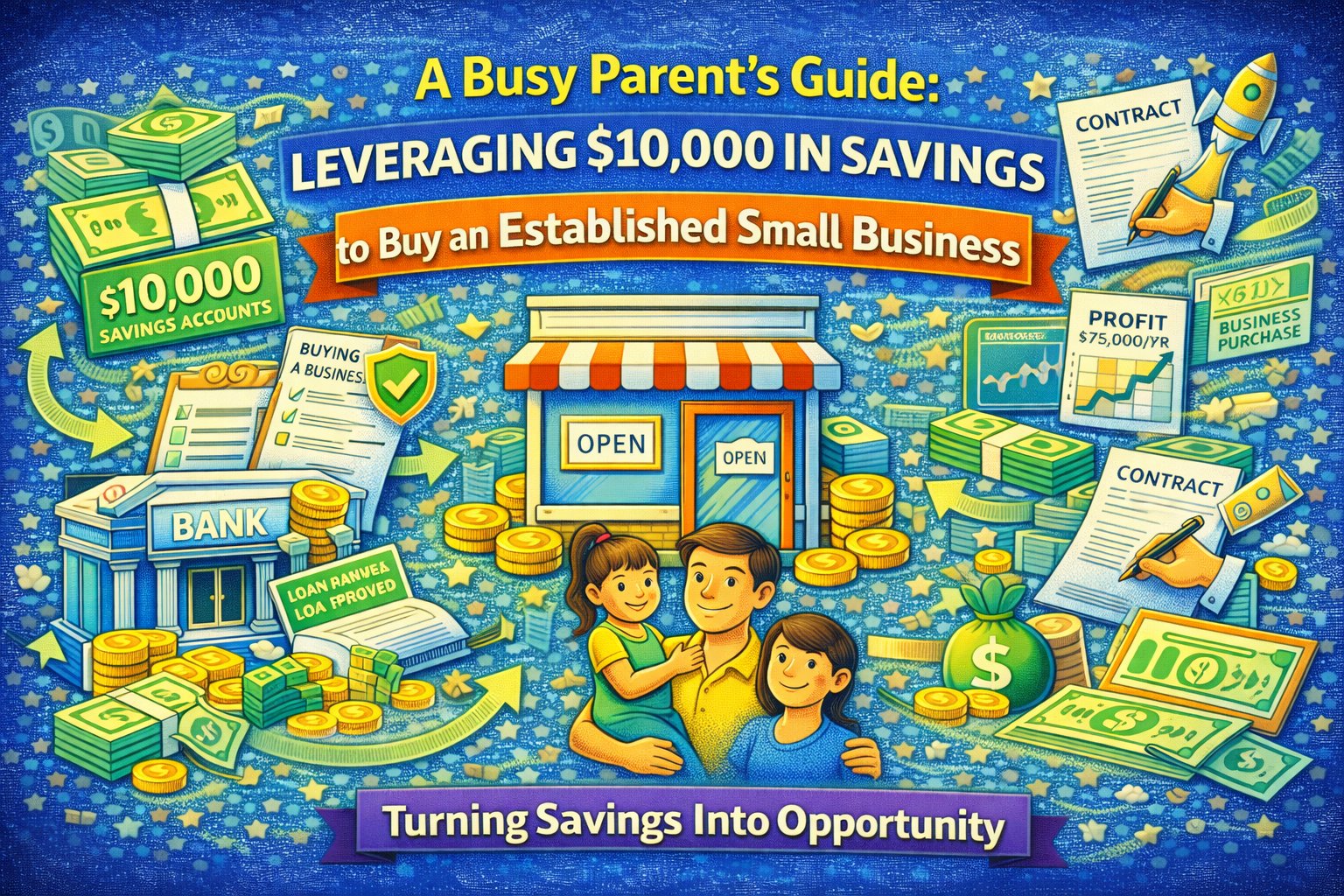
If you’re a busy parent, time is your most limited resource.
You don’t have bandwidth for high-risk startups, endless experimentation, or speculative investments.
But you do have something powerful:
-
Income stability
-
Real-world management skills
-
Long-term thinking
-
A savings cushion
The question becomes:
Can $10,000 realistically position you to buy an established small business?
Yes — but only with strategy, leverage, and disciplined modeling.
This guide walks through:
-
What kind of businesses $10,000 can realistically control
-
How leverage works in small acquisitions
-
Financing structures that reduce capital requirements
-
Risk-adjusted modeling
-
Time-management considerations for parents
-
A conservative wealth-building roadmap
Let’s build this properly.
Step 1: Reset the Mental Model
$10,000 does not buy a $10,000 business.
It becomes:
-
A down payment
-
A credibility signal
-
A due diligence fund
-
A working capital reserve
Most established small businesses sell between:
-
2x–3x Seller’s Discretionary Earnings (SDE)
If a business produces:
$75,000 SDE annually
At 2.5x multiple → $187,500 valuation
You are not buying it outright.
You are structuring it.
Step 2: What Businesses Work for Busy Parents?
You need:
-
Predictable revenue
-
Low emergency calls
-
Limited inventory complexity
-
Strong manager or staff continuity
Ideal categories:
-
Niche service businesses
-
Local route-based businesses
-
Digital content sites
-
Bookkeeping or admin service firms
-
Subscription-based services
Avoid:
-
Restaurants
-
High-inventory retail
-
Construction startups
-
Owner-operator burnout models
You are buying income stability, not chaos.
Step 3: Leveraging $10,000 Through Deal Structure
The key is structure.
Scenario Example
Business price: $180,000
SDE: $90,000
Deal structure:
-
$10,000 buyer down payment
-
$30,000 seller note
-
$140,000 SBA loan via U.S. Small Business Administration
Down payment: $10,000 (plus closing costs)
Annual debt payments ≈ $25,000–$30,000 (depending on terms)
Remaining annual cash flow:
$90,000 – $28,000 = $62,000 pre-tax
You invested $10,000.
Return on cash invested is extraordinary — if the model holds.
Leverage magnifies outcomes.
Step 4: Debt Service Coverage Ratio (DSCR)
Before proceeding, calculate:
DSCR = Net Operating Income ÷ Debt Payments
Using example:
$90,000 ÷ $28,000 ≈ 3.2
Lenders typically require ≥1.25.
This model is strong.
Now stress-test:
If revenue drops 25%:
Adjusted SDE = $67,500
Debt = $28,000
Remaining ≈ $39,500
Still viable — but tighter.
Never rely on optimistic assumptions.
Step 5: Time Modeling for Parents
You must quantify time.
Ask:
-
How many hours per week required?
-
Can operations be delegated?
-
Is there a manager?
-
Can tasks be automated?
Ideal acquisition:
-
10–20 hours per week
-
Systems documented
-
Staff trained
Your lifestyle matters.
Financial modeling must include time cost.
Step 6: Risk Buffer Allocation
Of your $10,000:
-
$7,000 down payment
-
$1,500 due diligence + legal
-
$1,500 working capital reserve
Never deploy all savings.
Maintain:
-
Separate emergency fund
-
Household stability
Business risk should not destabilize family finances.
Step 7: Advanced Return Modeling
Let’s compare three scenarios.
Conservative Scenario
SDE: $90,000
Debt: $30,000
Net: $60,000
You reinvest $30,000 annually into debt reduction.
In 3 years:
Loan substantially reduced.
Cash flow increases.
Moderate Growth Scenario
Increase revenue 10% annually through:
-
Marketing optimization
-
Cross-selling
-
Pricing improvements
Year 3 SDE ≈ $120,000+
Sell at 3.5x multiple:
$420,000 valuation
You turned $10,000 into six-figure equity.
Downside Scenario
Revenue drops 30%:
SDE = $63,000
Debt = $28,000
Remaining ≈ $35,000
Still positive — but only if costs remain controlled.
Downside protection matters more than upside fantasy.
Step 8: The Multiple Arbitrage Strategy
Small businesses sell cheaper than larger ones.
Buy at 2.5x.
Systematize.
Grow.
Sell at 4x.
Example:
Purchase at $180,000
Grow SDE to $120,000
Exit at 4x → $480,000
Equity expansion = strategic wealth creation.
Step 9: The Parent Advantage
Busy parents possess advantages:
-
Discipline
-
Scheduling precision
-
Resource management
-
Long-term perspective
Those traits outperform aggressive but inconsistent entrepreneurs.
Step 10: Financing Alternatives
If SBA route is difficult:
Seller Financing Only
Negotiate 10% down.
Seller carries 90%.
Tie repayment to revenue performance.
Earn-Out Structure
Pay part of purchase price over time based on performance.
Partnership Model
Bring operational partner.
You provide capital and strategy.
Step 11: Psychological Discipline
Avoid:
-
Emotional purchases
-
“Lifestyle” businesses
-
Overestimating add-backs
-
Underestimating transition friction
Buying a business is not glamorous.
It is operational execution.
Step 12: 5-Year Wealth Projection Model
Year 1:
Acquire business. Stabilize.
Year 2:
Improve margins.
Year 3:
Refinance or extract equity.
Year 4:
Acquire second business using cash flow.
Year 5:
Portfolio produces $150,000–$250,000+ annually.
This is compounding through ownership.
Step 13: When This Strategy Makes Sense
Proceed if:
-
Household finances are stable
-
Emergency fund exists
-
You understand financial statements
-
You can tolerate moderate stress
-
You value ownership over speculation
Avoid if:
-
You have unstable income
-
You lack time discipline
-
You prefer passive investing only
-
You carry high-interest debt
Final Perspective
$10,000 alone will not make you wealthy.
But strategically leveraged, it can control assets that generate:
-
Cash flow
-
Equity
-
Long-term wealth
For a busy parent, the objective is not hustle culture.
It is:
-
Predictable income
-
Controlled risk
-
Structured leverage
-
Long-term compounding
Ownership changes financial trajectory.
Not overnight.
But systematically.


Leave a Reply