
Want to make extra money but don’t have hundreds or thousands of dollars to invest? You’re not alone.
One of the biggest misconceptions about starting a side hustle is that you need substantial startup capital, expensive equipment, or specialized training.
The truth is that some of the most accessible side hustles can be started for less than $100—especially if you already own a smartphone, computer, or reliable internet connection.
Whether you’re trying to pay off debt, build an emergency fund, save for a family vacation, or create an additional income stream, the right side hustle can help you work toward your financial goals.
The key is choosing an opportunity that matches your skills, schedule, and available resources.
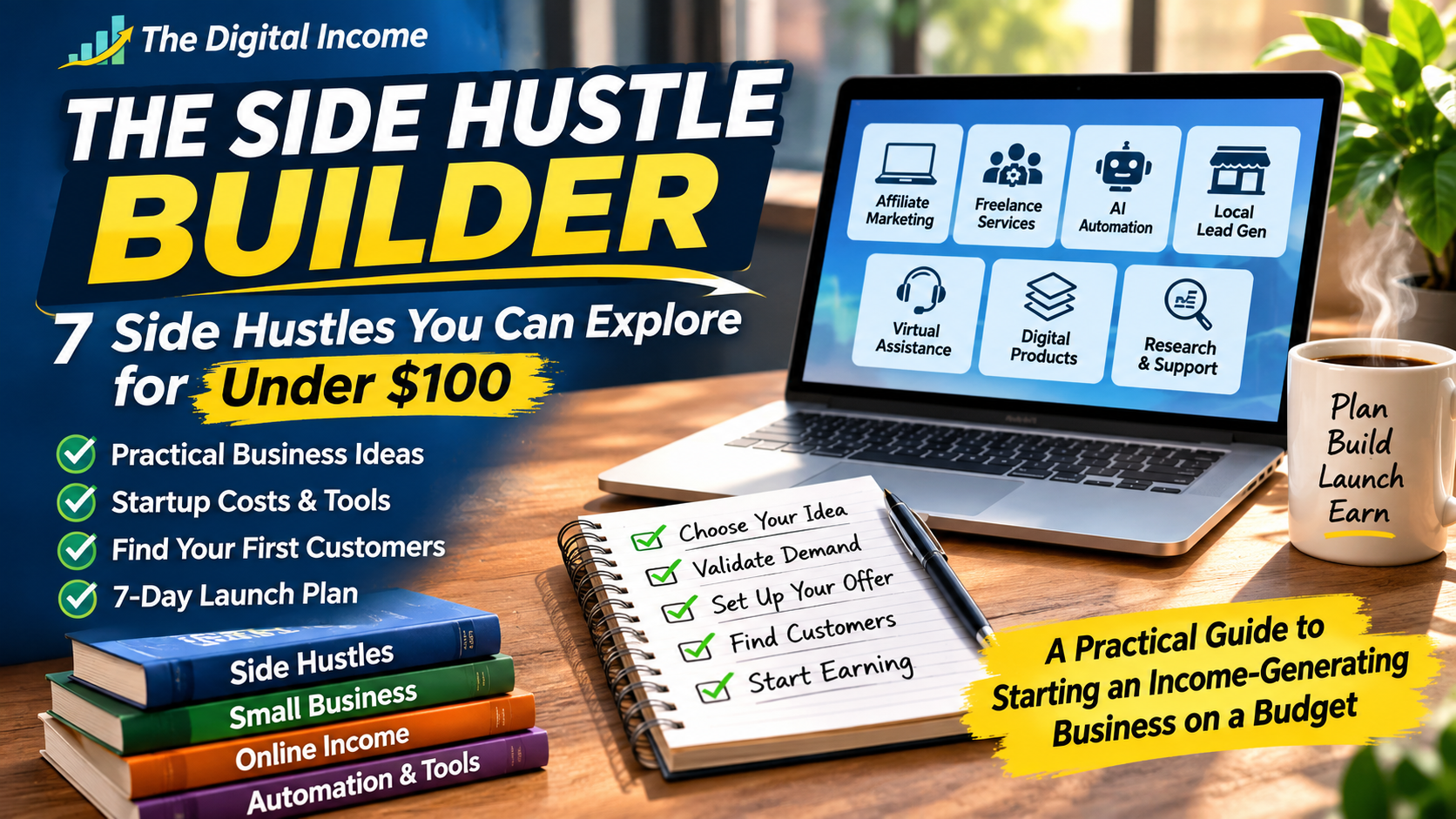
In this guide, we’ll explore seven low-cost side hustles you can start for under $100, what you need to get started, how to find your first customers, and ways to turn a small income opportunity into something more sustainable.
You’ll also discover how to choose the best side hustle for your lifestyle—without sacrificing every evening or weekend.

Quick Comparison: 7 Side Hustles Under $100
| Side Hustle | Estimated Startup Cost | Income Model | Best For |
|---|---|---|---|
| Freelance services | $0–$50 | Project or hourly fees | People with marketable skills |
| Virtual assistant | $0–$50 | Hourly or monthly retainers | Organized, detail-oriented people |
| Digital products | $0–$75 | Sales of downloadable products | Creative or analytical people |
| Affiliate marketing | $0–$100 | Commissions on qualified referrals | Content creators and marketers |
| Local business social media support | $0–$50 | Monthly client retainers | People familiar with social platforms |
| Online tutoring | $0–$50 | Hourly sessions | People who enjoy teaching |
| Local service coordination | $0–$100 | Service fees or referral income | People who enjoy organizing and selling |
These estimates assume you already have access to basic equipment and internet service. Actual costs, demand, fees, taxes, and earnings will vary.
1. Freelance Services: Turn Your Existing Skills Into Income
Estimated startup cost: $0–$50
One of the fastest ways to explore a side hustle is to sell a skill you already possess.
You don’t necessarily need a professional certification or years of business experience to offer useful services. Many individuals and small businesses need help with everyday tasks they don’t have the time or expertise to complete.
Freelance services you can offer
-
Writing and editing blog posts
-
Creating spreadsheets and financial trackers
-
Designing presentations
-
Managing email newsletters
-
Providing basic website updates
-
Researching business opportunities
-
Organizing digital documents
-
Offering technical support within your expertise
For example, someone comfortable with Excel or Google Sheets could offer to organize a small business’s expense tracker.
A digital marketer could help a business improve its email welcome sequence.
A strong writer could help an entrepreneur publish better website content.
How much could you earn?
Consider a hypothetical freelancer who charges $75 for a clearly defined project.
Completing four projects per month would generate $300 in gross revenue.
As your portfolio, expertise, and reputation grow, you may be able to charge more or transition to recurring client relationships.
However, earnings depend on customer demand, competition, delivery time, and your ability to market your services.
How to get started
-
Identify one skill you can confidently deliver.
-
Define a specific service and outcome.
-
Create one demonstration of your work.
-
Share your offer on LinkedIn or with relevant professional contacts.
-
Approach potential customers with a personalized explanation of how you can help.
Best strategy: Start with one service instead of offering everything.
A clear offer such as “I’ll organize your monthly business expense spreadsheet” is easier to understand than “I provide general business services.”
2. Virtual Assistant: Help Entrepreneurs Stay Organized

Estimated startup cost: $0–$50
Business owners often spend hours managing calendars, organizing emails, preparing documents, researching suppliers, and handling administrative tasks.
A virtual assistant helps them manage those responsibilities remotely.
This can be an attractive side hustle because you may already possess many of the necessary skills.
Services you could provide
-
Calendar and appointment coordination
-
Inbox organization
-
Data entry and spreadsheet maintenance
-
Customer inquiry management
-
Online research
-
CRM updates
-
Document formatting
-
Newsletter scheduling
You can start with free versions of common productivity tools, although clients may require you to work within their existing systems.
Potential earnings
Suppose you establish a recurring arrangement for five hours per week at $20 per hour.
That represents approximately $400 in gross revenue over a four-week period.
Two similar clients could generate approximately $800 over four weeks, before expenses and taxes.
These figures illustrate the arithmetic, not guaranteed rates or available work.
How to find clients
Look for small businesses, consultants, solo entrepreneurs, and service providers who need administrative assistance but aren’t ready to hire a full-time employee.
Your strongest pitch should focus on the business outcome.
Instead of saying, “I’m looking for virtual assistant work,” try:
“I help small business owners reclaim time by organizing their inboxes, calendars, and recurring administrative tasks.”
Growth opportunity
Once you develop reliable processes, you can offer monthly service packages.
Recurring client relationships can make your income more predictable than constantly searching for one-time assignments.
FREE RESOURCE: Find the Right Side Hustle for Your Budget
Not sure which opportunity fits your skills, available time, and income goals?
Download the Free Side Hustle Builder Starter Kit.
Inside, you’ll get:
-
A side hustle comparison worksheet
-
A simple startup budget planner
-
A skills and resources inventory
-
A first-customer outreach checklist
-
A 30-day launch action plan
[Get Your Free Side Hustle Builder Kit →]
Enter your email to receive the toolkit and practical side hustle ideas from The Digital Income. You can unsubscribe anytime.
3. Sell Digital Products: Create Something Once and Sell It Repeatedly

Estimated startup cost: $0–$75
Digital products can be an appealing side hustle because you don’t need to manage physical inventory, packaging, or shipping.
You create a useful downloadable resource and make it available for customers to purchase online.
Examples include:
-
Budgeting spreadsheets
-
Debt payoff trackers
-
Savings challenge templates
-
Business planning worksheets
-
Digital planners
-
Checklists
-
Resume templates
-
Educational guides
Why digital products are attractive
A physical product generally has manufacturing or inventory costs associated with each sale.
A digital product can often be delivered repeatedly at a relatively low incremental cost.
That doesn’t mean digital products are passive income from day one.
You’ll still need to create something useful, attract customers, maintain the product, answer questions, and occasionally issue refunds.
Example earning scenario
Imagine creating a budgeting spreadsheet and selling it for $15.
| Monthly Sales | Gross Revenue |
|---|---|
| 5 sales | $75 |
| 20 sales | $300 |
| 50 sales | $750 |
| 100 sales | $1,500 |
These figures exclude marketplace fees, payment processing, advertising, refunds, and taxes. Reaching those sales volumes requires real customer demand and effective distribution.
How to start for under $100
Begin with a tool you already know, such as Google Sheets, Excel, or a free design application.
Create one product that solves a specific problem.
For example, a household budgeting template might help users:
-
Track monthly income
-
Organize recurring bills
-
Categorize spending
-
Set savings goals
-
Review cash flow
Then create a simple product description explaining who it’s for and what it helps them accomplish.
You can sell through a digital-product marketplace or an existing website, depending on platform fees and functionality.
How to get your first sale
Before spending money on advertisements, show the product to people who match your intended audience.
Ask them whether the resource solves a meaningful problem and what they’d improve.
A few genuine customer conversations can be more useful than creating ten products nobody wants.
Growth opportunity: Build a small collection of complementary products, such as a budgeting workbook, debt tracker, and savings planner.
4. Affiliate Marketing: Earn Commissions by Recommending Useful Products

Estimated startup cost: $0–$100
Affiliate marketing allows you to earn commissions when someone completes a qualifying action through your unique referral link.
Depending on the program, that action might be a purchase, subscription, or approved account opening.
This is particularly relevant if you enjoy writing, teaching, reviewing products, or building an online audience.
How affiliate marketing works
-
Choose a topic or audience you understand.
-
Apply to an appropriate affiliate program.
-
Create useful content around a genuine customer problem.
-
Include relevant affiliate links with clear disclosures.
-
Earn a commission when a qualifying conversion occurs.
For example, a personal finance website might publish educational articles about budgeting tools, savings strategies, or financial organization software.
An article comparing budgeting apps could include links to products the publisher has reviewed.
How much can you earn?
Affiliate commissions vary significantly.
Suppose a program pays $20 for each qualified referral.
| Qualified Referrals | Gross Commission Revenue |
|---|---|
| 5 | $100 |
| 10 | $200 |
| 25 | $500 |
| 50 | $1,000 |
These are hypothetical calculations, not promises of income or representations of a particular affiliate program.
Some programs also impose approval requirements, minimum payout thresholds, traffic restrictions, and commission reversal policies.
The biggest mistake beginners make
Many people join affiliate programs and immediately begin posting links.
But links alone rarely create a sustainable business.
The better strategy is to build trust by answering questions your audience is already asking.
For example:
-
How do I start budgeting with irregular income?
-
Which expenses should I track first?
-
What tools help freelancers organize their finances?
-
How can I build an emergency fund on a limited income?
Useful educational content can attract readers who are genuinely interested in the solutions you recommend.
Why an email list matters

Search engine and social media traffic can fluctuate.
An email list lets you keep providing value to readers who voluntarily subscribe.
A simple affiliate funnel might look like this:
Helpful article → Free resource → Email newsletter → Relevant product recommendation
Always disclose affiliate relationships clearly and follow the terms of each program.
Growth opportunity: Combine blog content, an email newsletter, and carefully selected affiliate partnerships instead of relying on one traffic source.
FREE DOWNLOAD: Build Your First Side Hustle Without Overspending
You don’t need an expensive course or complicated business plan to begin.
The Side Hustle Builder Starter Kit helps you choose one realistic opportunity and organize your first steps.
You’ll learn how to:
-
Compare startup costs
-
Identify skills you can monetize
-
Plan your first $100
-
Set realistic revenue targets
-
Outline your first 30 days
[Download the Free Side Hustle Builder Kit →]
Join The Digital Income newsletter for practical ideas on earning, saving, and managing money.
5. Local Business Social Media Support: Help Businesses Reach More Customers
Estimated startup cost: $0–$50
Many local businesses understand that social media matters but struggle to post consistently.
Restaurants, cleaning companies, auto repair shops, independent retailers, and service businesses may need help creating content, organizing promotions, and maintaining their online presence.
You don’t necessarily need to become a full-service advertising agency to help.
Start with a simple, well-defined service.
What you can offer
-
Creating a monthly content calendar
-
Writing social media captions
-
Scheduling approved posts
-
Designing simple promotional graphics
-
Updating business profiles
-
Preparing basic engagement reports
Example service package
Consider offering a starter package that includes:
Monthly Social Media Content Support — $199
-
Eight prepared social media posts
-
Captions and relevant calls to action
-
Basic content scheduling
-
A short monthly performance summary
The $199 figure is an illustrative starting price. Your actual pricing should account for production time, revisions, platform access, and customer requirements.
Three clients paying $199 per month would generate $597 in monthly gross revenue.
How to find customers
Start by reviewing the online presence of businesses in your community.
Look for opportunities where you can provide a specific improvement.
For example, a business may have useful services but rarely post photos, customer information, or timely updates.
Reach out professionally with one practical suggestion.
Avoid criticizing the business or making unsupported promises about follower growth.
How to scale
Once you develop reusable templates and an efficient production process, you may be able to support multiple clients without proportionally increasing your workload.
The most important factor is managing scope.
Clearly define how many posts, revisions, platforms, and reports are included in each package.
6. Online Tutoring: Get Paid to Teach What You Know
Estimated startup cost: $0–$50
If you enjoy explaining concepts and helping others learn, online tutoring could be a practical side hustle.
Potential subjects include:
-
Mathematics
-
English and writing
-
Basic computer skills
-
Spreadsheet fundamentals
-
Language conversation practice
-
Business software
-
Academic subjects you are qualified to teach
You can offer sessions remotely using an appropriate video conferencing platform.
Example earnings
At a hypothetical rate of $25 per session, completing eight one-hour sessions per month would generate $200 in gross revenue.
More specialized subjects may support different pricing, depending on qualifications, demand, and competition.
How to get started
Choose a subject you can teach confidently.
Define your target learner and the outcome of your sessions.
For example:
“I help beginners learn Excel formulas, organize spreadsheets, and build confidence using everyday business tools.”
Create a simple lesson outline and explain what students should expect.
You can explore tutoring platforms, community groups, and professional networks, while checking any platform fees or qualification requirements.
If you work with minors, follow applicable safeguarding requirements and use appropriate parent or guardian communication and consent practices.
Growth opportunity
As you gain experience, you may be able to offer small-group sessions, workshops, or original educational resources.
This can help diversify your income beyond individual tutoring appointments.
7. Local Service Coordination: Connect Customers With Reliable Service Providers
Estimated startup cost: $0–$100
Not every side hustle requires you to personally perform the service.
Some businesses generate revenue by organizing customer requests, scheduling work, and coordinating service providers.
Potential examples include:
-
Home cleaning coordination
-
Lawn care scheduling
-
Administrative support for local contractors
-
Appointment coordination
-
Property maintenance request management
The business model is based on solving a coordination problem.
However, it’s important to distinguish administrative coordination from operating as a contractor, employment agency, or regulated referral service.
Some activities require licenses, insurance, written agreements, or specific disclosures depending on your location and the work involved.
How the model could work
Imagine a small cleaning business that receives inquiries but struggles to respond quickly.
You could offer a defined administrative service that helps the owner:
-
Organize incoming customer requests.
-
Record requested service dates.
-
Coordinate appointment availability.
-
Send customer confirmations.
-
Maintain a simple scheduling tracker.
Instead of collecting a commission from a regulated referral arrangement, you could initially charge the business a fixed administrative service fee.
This keeps the offer relatively simple, although you still need appropriate agreements and data-handling practices.
Example income model
Two small businesses paying $150 per month for limited scheduling and inquiry management would generate $300 in monthly gross revenue.
The workload and profitability depend on inquiry volume, customer expectations, and the systems you use.
Growth opportunity
Once you’ve documented the workflow, you may be able to automate parts of the process using forms, calendars, email notifications, and spreadsheets.
The goal is to deliver reliable service without becoming personally responsible for every task.
Which Side Hustle Is Best for You?
The most profitable opportunity on paper isn’t necessarily the best opportunity for your circumstances.
A side hustle that requires constant customer interaction may not fit someone with a demanding full-time job.
Likewise, an online business that takes months to attract traffic may not be ideal for someone who needs immediate cash.
Consider these questions before choosing:
1. How quickly do you need income?
Freelancing and administrative services may offer a more direct path to your first paying customer. Affiliate marketing and digital products often require more audience-building.
2. How much time can you consistently invest?
Choose an opportunity that fits your actual weekly schedule rather than an unrealistic ideal.
3. What skills or resources do you already have?
Using existing skills and equipment can reduce startup costs.
4. Do you prefer working with clients or selling products?
Service businesses involve direct client relationships. Digital products and affiliate marketing depend more heavily on distribution and marketing.
5. Can the opportunity grow without consuming all your free time?
Recurring contracts, reusable products, documented workflows, and automation may create opportunities to increase efficiency.
Quick Side Hustle Selection Guide
| Your Situation | Consider Starting With |
|---|---|
| Need income relatively quickly | Freelancing or virtual assistance |
| Enjoy creating templates | Digital products |
| Like writing and marketing | Affiliate marketing |
| Have strong organizational skills | Virtual assistance or service coordination |
| Enjoy teaching | Online tutoring |
| Know social media well | Local business content support |
| Want recurring client revenue | Virtual assistance or social media services |
There is no universally best option. Choose the one that offers a realistic combination of demand, affordability, personal fit, and available time.
How to Start a Side Hustle With Your First $100
You don’t have to spend the entire $100 just because it’s available.
In fact, preserving your cash while validating demand is often the smarter approach.
Here’s an illustrative startup budget:
| Expense | Budget |
|---|---|
| Basic tools or supplies | $20 |
| Simple branding or materials | $10 |
| Portfolio or product development | $0 |
| Optional customer acquisition test | $20 |
| Reserve for unexpected expenses | $50 |
| Total | $100 |
This is a flexible example, not a required spending plan. Depending on your business, legal or insurance costs could exceed $100, so confirm those requirements before accepting paid work.
Your First 30 Days
Week 1: Choose one opportunity
Identify your target customer, the problem you solve, and the minimum resources required.
Week 2: Create your first offer
Prepare a sample, service description, lesson plan, or digital product prototype.
Week 3: Find potential customers
Use appropriate professional networks, online communities, existing contacts, or relevant marketplaces to test interest.
Week 4: Review your results
Track conversations, inquiries, sales, expenses, and time invested.
If customers aren’t responding, adjust the offer before spending more money.
The goal of your first month isn’t to build a massive business.
It’s to determine whether people value what you’re offering enough to pay for it.
Frequently Asked Questions
What is the cheapest side hustle to start?
Freelancing, virtual assistance, and online tutoring can have very low startup costs if you already own the necessary equipment and have suitable skills. However, acquiring customers may take time.
Can I really start a side hustle with $100?
Yes, some service-based and digital side hustles can be explored with $100 or less. Actual costs depend on equipment, software, platform fees, licensing, insurance, and other requirements.
Which side hustle can make money the fastest?
Selling an existing skill to a paying customer may provide a more direct path to revenue than building a blog, affiliate audience, or digital product store. However, there is no guaranteed timeline for earning money.
Are digital products passive income?
Digital products can be delivered automatically, but creating, marketing, supporting, and updating them still requires work. Sales are not guaranteed.
Is affiliate marketing worth starting with no money?
Affiliate marketing can be explored at low cost, especially if you already have a website or audience. It generally requires consistent content creation, relevant traffic, and trustworthy recommendations before meaningful commissions become likely.
How do I choose a side hustle while working full-time?
Start with your available time, existing skills, and income goals. Favor opportunities that can be performed in predictable blocks and don’t require constant availability.
Do I have to pay taxes on side hustle income?
In the United States, income from side hustles is generally taxable, even if you don’t receive a tax form. Depending on your net self-employment earnings and circumstances, self-employment tax and estimated tax payments may apply. Keep accurate records and consult IRS guidance or a qualified tax professional.
Final Thoughts: Start Small, Learn Fast, and Build From There
Starting a side hustle doesn’t have to mean risking your savings, quitting your job, or investing in expensive business software.
Sometimes the best first step is identifying one problem you can solve using the skills and resources you already have.
Freelancing, virtual assistance, digital products, affiliate marketing, social media support, online tutoring, and local service coordination each offer different paths to earning additional income.
The opportunity you choose should support your financial goals and fit your lifestyle.
Start with one idea. Validate demand. Track your results. Improve your process.
Over time, a well-managed side hustle may become a valuable additional income stream.
Ready to Explore Your First Side Hustle?
Stop guessing which opportunity might work for you.
Download The Digital Income’s Free Side Hustle Builder Starter Kit and create a practical plan around your skills, budget, and available time.
[Download My Free Side Hustle Builder Kit →]
You’ll also receive practical ideas on side hustles, budgeting, saving, and building additional income streams from The Digital Income.
The Digital Income provides educational information, not individualized financial, tax, or legal advice. Earnings examples are illustrative and do not guarantee results.


Leave a Reply