
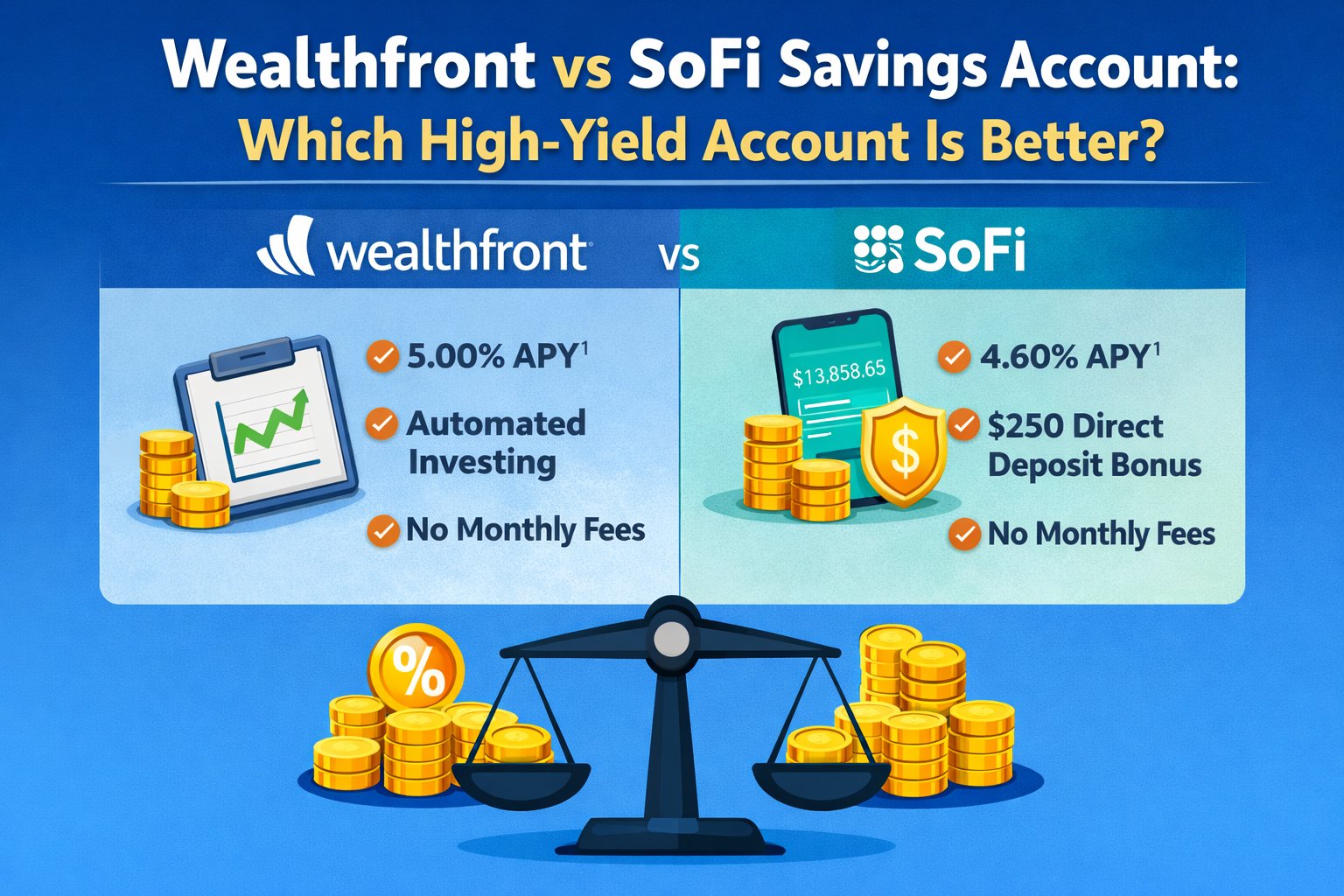
When someone searches for a high-yield savings account, they’re rarely just comparing interest rates — they’re choosing a system for handling money.
Two names dominate that decision today: Wealthfront Cash Account and SoFi Savings.
On paper, they look nearly identical:
-
Both advertise competitive APY
-
Both have no monthly fees
-
Both are fully online
-
Both integrate with modern financial apps
But once you actually use them, you realize something important:
These accounts are built around completely different human behaviors.
I personally tested Wealthfront and documented my full experience here:
https://thedigitalincome.com/comprehensive-review-of-wealthfronts-cash-account/
This guide breaks down the real-world differences so you can confidently choose the one that fits how you actually manage money — not how banks wish you did.
Quick Comparison
| Feature | Wealthfront Cash Account | SoFi Savings |
|---|---|---|
| Account Type | Cash Management Account | Online Bank Account |
| APY Structure | Always active | The highest rate requires conditions |
| Minimum Balance | $0 | $0 |
| Direct Deposit Required | No | Yes (for max APY) |
| Automation | Advanced auto-optimization | Basic auto-save |
| Bill Pay | No | Yes |
| Debit Card | No | Yes |
| Early Paycheck | No | Yes |
| ATM Access | No | Yes |
| Best Use | Passive savings engine | Daily banking hub |
The Core Difference (Most People Miss This)
The real comparison is not rate vs rate.
It’s:
Automation vs Activity
Wealthfront
Built to grow money without interaction
SoFi
Built to replace your main bank account
If you misunderstand this distinction, you’ll pick the wrong one — even if the APY looks better.
Interest Earnings: Passive vs Active Banking
Wealthfront — The Passive Growth Model
Wealthfront treats your cash like an asset that should be continuously optimized.
Once money enters the account, it starts earning — no requirements, no behavior triggers, no ongoing tasks.
You do NOT need to:
-
Set up payroll deposits
-
Make purchases
-
Maintain transactions
-
Use a debit card
-
Log in frequently
The account is designed around a single assumption:
People are bad at consistently managing savings behavior.
So instead of motivating activity, Wealthfront eliminates the need for it.
Your idle cash simply sits across partner banks and compounds automatically.
If you want to see how this actually behaves in practice — transfers, buckets, and earnings — I documented the full walkthrough here:
https://thedigitalincome.com/comprehensive-review-of-wealthfronts-cash-account/
SoFi — The Engagement Model
SoFi approaches banking from the opposite direction.
They want to become your financial headquarters.
To unlock the best interest rate, you typically need to:
-
Set up direct deposit
-
Use the account regularly
-
Treat it as checking + savings combined
SoFi rewards financial activity.
Wealthfront rewards financial distance.
That single design choice determines which one works better for you.
Daily Usability
Where SoFi Wins — Everyday Banking
SoFi behaves like a traditional bank replacement, but modernized.
You get:
-
Debit card spending
-
ATM reimbursements
-
Bill pay system
-
Early paycheck access
-
Mobile banking features
This makes SoFi extremely practical for someone who wants one account that does everything.
Instead of splitting money between checking and savings, your financial life stays centralized.
This reduces complexity — but increases visibility of your cash.
And visibility influences spending.
Where Wealthfront Wins — Cash Storage Optimization
Wealthfront deliberately removes daily banking tools.
You don’t get:
-
A debit card
-
Bill pay
-
Constant spending access
Instead, you get:
-
Automatic transfers
-
Savings categories (buckets)
-
Continuous yield optimization
-
Behavioral separation from spending
It functions less like a bank and more like a financial allocation system.
Many users discover they spend less simply because the money is not constantly visible in their spending account.
Automation & Behavioral Finance
Most financial advice fails because it assumes discipline.
Real financial systems assume psychology.
Wealthfront’s biggest advantage is not APY — it’s friction design.
Humans tend to spend money they frequently see.
Checking accounts maximize visibility.
Savings accounts reduce it.
Wealthfront amplifies this effect.
By separating storage from spending:
-
Fewer impulse purchases occur
-
Savings consistency improves
-
Decisions become intentional instead of reactive
SoFi, by contrast, encourages engagement, which works well for organized users but poorly for reactive spenders.
Neither is objectively better.
They’re better for different personalities.
Real-World Scenarios
Scenario 1: The Busy Professional
You get paid, pay bills, and don’t want to micromanage finances.
Better choice: Wealthfront
Reason: automatic growth without maintenance.
Scenario 2: The Simplifier
You want one account to run your entire financial life.
Better choice: SoFi
Reason: full banking functionality.
Scenario 3: The Impulse Spender
Money in checking disappears faster than expected.
Better choice: Wealthfront
Reason: behavioral separation.
Scenario 4: The Structured Budgeter
You track expenses and prefer central control.
Better choice: SoFi
Reason: integrated daily management.
Hidden Tradeoffs Most Reviews Ignore
The APY Illusion
Many comparisons obsess over tiny rate differences.
In reality:
Consistency beats rate.
An account earning slightly less but used properly will outperform a higher-rate account used inconsistently.
Wealthfront increases consistency.
SoFi increases convenience.
Your habits decide which produces more money over time.
The Visibility Cost
Combining checking + savings feels efficient.
But it increases cognitive spending triggers.
People don’t overspend because they lack knowledge —
They overspend because money is accessible.
Wealthfront intentionally reduces access friction.
Which Should You Choose?
Choose Wealthfront if:
-
You already have a checking account
-
You want savings separated
-
You value automation over involvement
-
You don’t want requirements for interest
-
You want a “set it and forget it” system
Choose SoFi if:
-
You want one financial hub
-
You rely on debit card purchases
-
You get paid via direct deposit
-
You pay bills from the same account
-
You prefer engagement over automation
Final Verdict
These are not true competitors.
They represent two financial strategies:
SoFi = Active money management
Wealthfront = Passive cash optimization
Neither is universally better — but one will fit your behavior far more naturally.
For people whose goal is to grow idle cash with minimal attention, Wealthfront typically aligns better.
I documented exactly why — including real usage screenshots and earnings behavior — here:
https://thedigitalincome.com/comprehensive-review-of-wealthfronts-cash-account/


Leave a Reply