
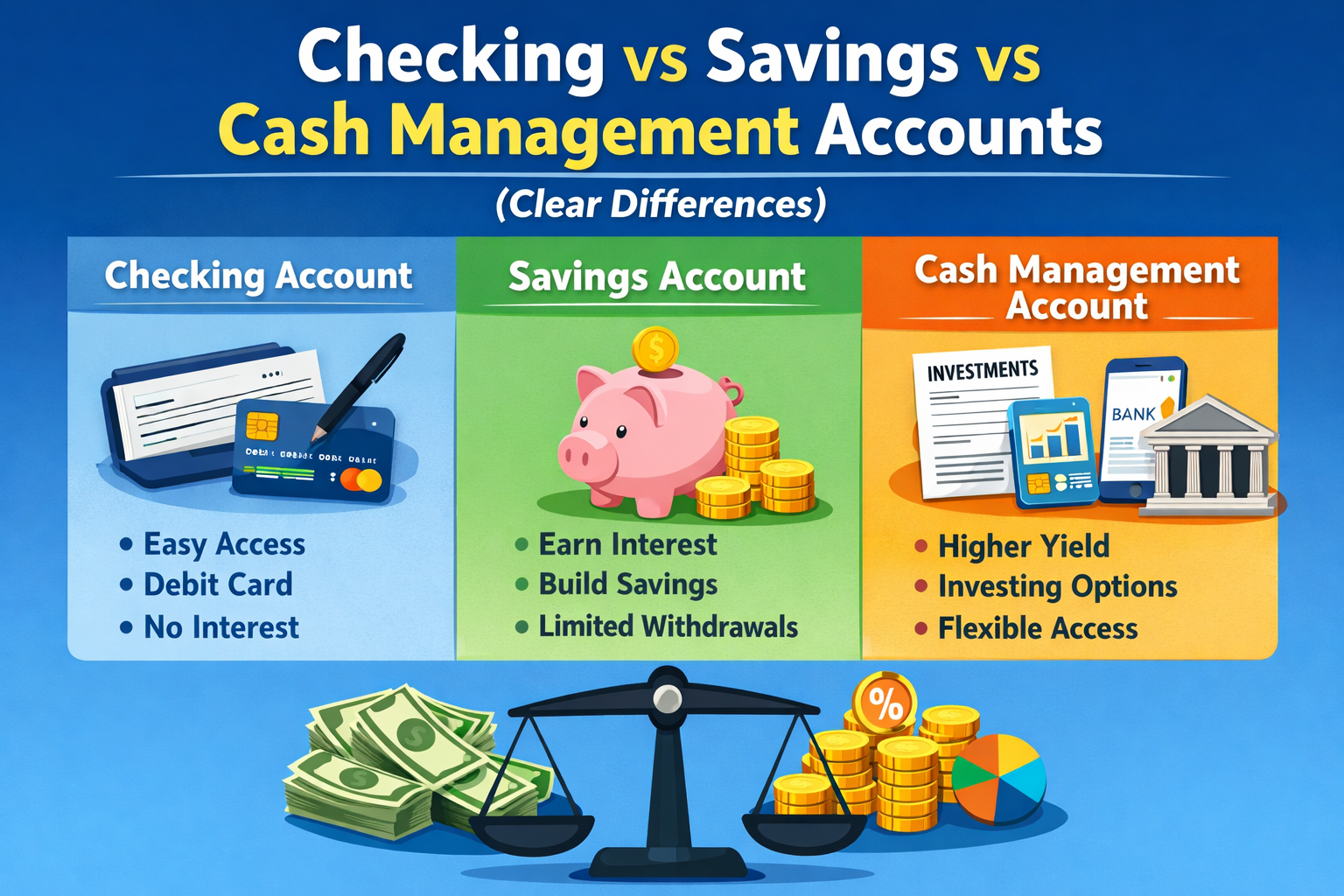
Most people think these three account types are interchangeable.
They are not.
They are designed for three distinct jobs within a healthy financial system.
Using the wrong account for the wrong purpose creates overspending, inconsistent saving, and financial stress — even when income is sufficient.
Instead of asking which account is best, the better question is:
What role should each account play?
Once each account has a defined responsibility, money management becomes dramatically easier.
You can see a practical, real-world structure example here:
https://thedigitalincome.com/comprehensive-review-of-wealthfronts-cash-account/
The Three-Layer Money System
Think of your finances as a workflow, not a container.
| Account Type | Role | Behavior Outcome |
|---|---|---|
| Checking | Movement | Spending |
| Savings | Storage | Holding |
| Cash Management | Separation | Consistency |
Each solves a different behavioral problem.
When combined correctly, budgeting becomes almost automatic.
Checking Account — The Transaction Engine
Purpose: movement
Checking accounts exist to handle money in motion.
They are optimized for speed, access, and convenience — not preservation.
Best Uses
-
Paying bills
-
Debit card purchases
-
Subscriptions
-
Everyday spending
-
Incoming paychecks
This is your operational wallet.
Strength
Maximum convenience
Weakness
Maximum visibility
Humans spend what they constantly see.
Keeping large balances in checking increases spending frequency without conscious awareness.
Checking accounts are designed for activity, which makes them poor storage locations.
Savings Account — The Holding Container
Purpose: storage
Savings accounts exist to hold money that shouldn’t be spent immediately but still needs to be accessible.
They introduce a small friction step between intention and action.
Best Uses
-
Short-term goals
-
Small reserves
-
Planned purchases
-
Temporary holding
Strength
Stable and predictable
Weakness
Requires manual discipline
Most savings failures happen here — not because of low interest, but because moving money requires repeated decisions.
You must constantly decide to save.
Over time, decision fatigue reduces consistency.
Cash Management Account — The Separation Layer
Purpose: automation and allocation
Cash management accounts are designed to solve a behavioral problem:
People don’t struggle with knowing they should save —
They struggle with doing it repeatedly.
Instead of relying on manual transfers, the system automatically allocates funds.
Typically Combines
-
Savings-level interest
-
Automatic transfers
-
Categorized reserves
-
Distance from spending
You can see a practical usage example here:
https://thedigitalincome.com/comprehensive-review-of-wealthfronts-cash-account/
Strength
Reduces reliance on discipline
Weakness
Not ideal for daily spending
It intentionally sits between checking and investing.
Why This Matters More Than Budgeting
Budgeting apps try to control behavior after money is visible.
Account structure controls behavior before spending happens.
| Method | Difficulty |
|---|---|
| Budget tracking | Requires constant attention |
| Account separation | Works automatically |
Structure beats willpower.
How Each Account Influences Behavior
Checking Encourages Spending
Immediate access = frequent use
Savings Encourages Decisions
Manual transfers = inconsistent habits
Cash Accounts Encourage Consistency
Automatic allocation = stable growth
Money location changes behavior more than financial knowledge.
The Ideal Financial Flow
A simple but effective system:
Income → Checking (operations)
Excess → Cash account (protection)
Surplus → Investments (growth)
Each dollar receives a job immediately after arriving.
This removes the common question:
“Can I afford this?”
Because the spending account already contains the answer.
Real-Life Example
Instead of holding $6,000 in checking:
-
$1,200 stays in checking (monthly spending)
-
$3,800 moves automatically to cash reserves
-
$1,000 goes toward long-term investing
Same income.
Different structure.
Completely different financial outcome.
Why Most People Struggle Without This
Without separation:
-
Spending and saving compete
-
Emergencies disrupt plans
-
Investing feels risky
With separation:
-
Spending becomes predictable
-
Emergencies stay contained
-
Investing becomes consistent
The accounts don’t just store money — they create decision boundaries.
Final Takeaway
These accounts are not competitors.
They are components of a complete financial system.
Checking manages activity.
Savings stores funds temporarily.
Cash management automates protection.
When used together, they reduce financial stress more effectively than tracking expenses alone.
See a working example here:
https://thedigitalincome.com/comprehensive-review-of-wealthfronts-cash-account/


Leave a Reply